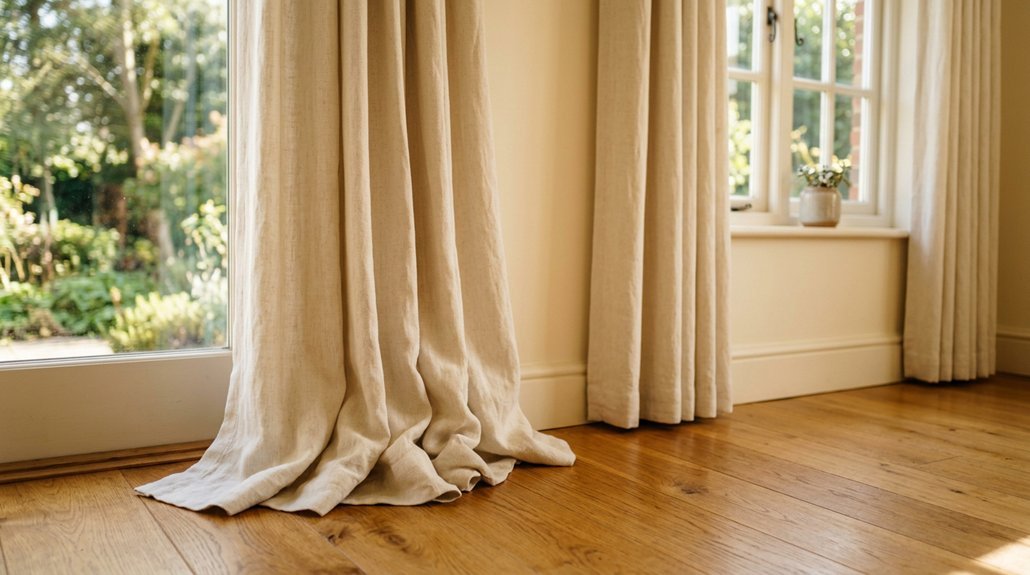

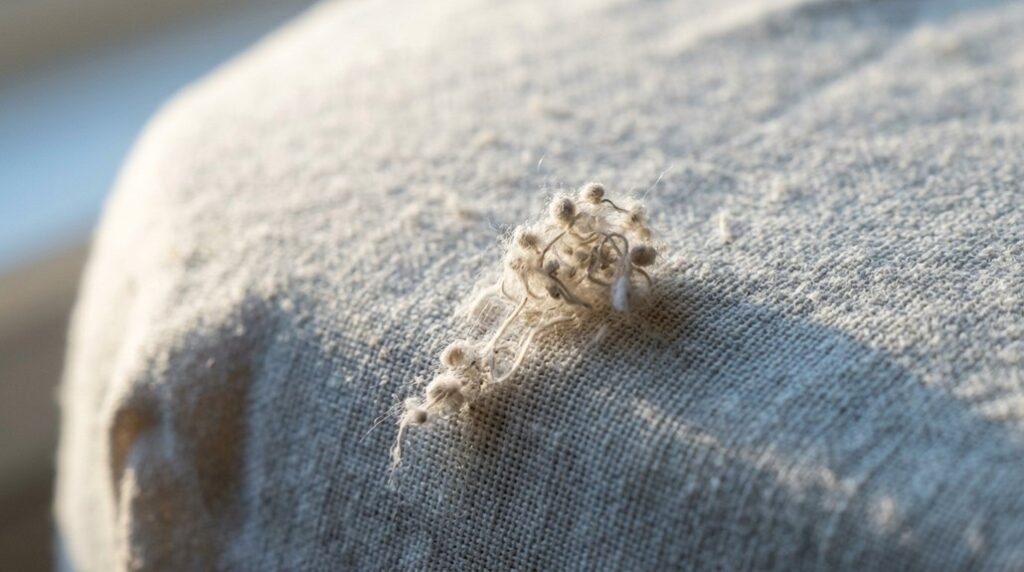
You notice those tiny balls forming on your favorite sheets, and you’re wondering what went wrong. The culprit isn’t always cheap fabric—sometimes your washing habits or water quality are silently shredding fibers. Before you toss another set, understand what’s really happening beneath the surface.
Why Your Sheets Pill: The Fibre Science Explained
Why do your sheets develop those annoying little fuzz balls? You’re witnessing pilling, where fibers break and tangle under friction into tiny surface balls. Your cotton sheets suffer most when short fibers dominate—fiber length matters enormously. When you’re washing sheets aggressively or overloading the machine, you’re increasing friction that snaps weaker fibers. Your fabric weave plays a role too; looser constructions let fibers migrate and mat together. You’ve probably noticed blends pill faster than quality options. While you’ll find pill remover tools handy for fixing damage, they don’t solve the root cause. Check labels for long-staple cotton indicators like Pima or Supima—you’re investing in fewer broken fibers. Your care habits directly determine how quickly pilling accelerates.
Recommended Products

Winner of the 2026 Good Housekeeping Best Bedding Award - Everyday Ease Cotton Sheets: Our 400 thread count queen size bed sheets are made with single-ply 100% long-staple cotton for a smooth hand feel and lightweight comfort. Independently tested to earn the prestigious Good Housekeeping Seal. Complete your bedding ensemble with this queen sheet set.

Winner Oprah Daily Sleep Award 2026 - Restful Retreat Sateen Sheet: Our 600 thread count white queen sheets set brings a balance of comfort and refinement. Made with single-ply 100% long-staple cotton, this weave offers a balanced feel between thickness and lightness. High-quality smoothness with a subtle luminous soft sheen. Independently tested to earn the prestigious Good Housekeeping Seal.
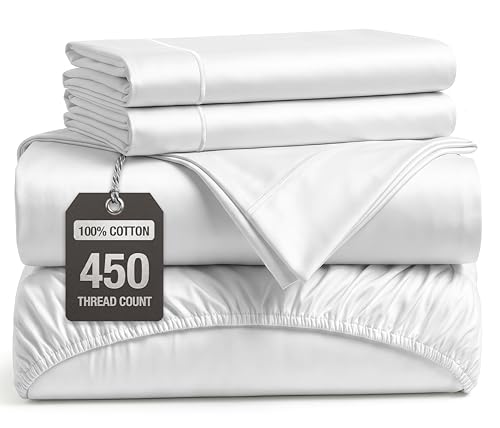
450 THREAD COUNT QUEEN SHEETS : Lane Linen's 450 thread count queen sheets are woven from 100% long-staple cotton in a smooth sateen weave for a soft, silky & breathable feel on skin and durable, luxury comfort all year round.
Why Long-Staple Cotton Resists Pilling Better
Sheet quality hinges on fiber length more than you might expect. Long-staple cotton gives you superior pill resistance because longer fibers resist breaking and rarely form loose ends that twist into pilling. You’ll notice Egyptian cotton and Pima cotton sheets feel smoother and stay cleaner-looking longer.
When you choose long-staple cotton, you’re getting fibers that align more securely in tightly woven yarns. This fiber length minimizes protruding hairs and lint, creating a cleaner surface that resists pilling over time. You avoid the stiff filaments that shorter blends introduce, which catch broken ends and accelerate pilling.
For lint prevention and lasting fabric softness, check labels carefully. Sources like Egyptian cotton, Pima cotton, Supima, or GOTS organic long-staple signal quality that protects your investment and keeps your sheets smooth wash after wash.
Recommended Products

OUR SHEET SET HAS EARNED THE GOOD HOUSEKEEPING SEAL - Luxury 100% Egyptian Cotton Sheets: This lightweight king percale sheet set is DNA-tested and certified with the Gold Seal by the Egyptian Cotton Association. Complete your bedding ensemble with these cotton sheets.
OUR SHEET SET HAS EARNED THE GOOD HOUSEKEEPING SEAL - Luxury 100% Egyptian Cotton Sheets: This lightweight percale queen Egyptian cotton sheet set is DNA-tested and certified with the Gold Seal by the Egyptian Cotton Association. Complete your bedding ensemble with this queen sheet set.
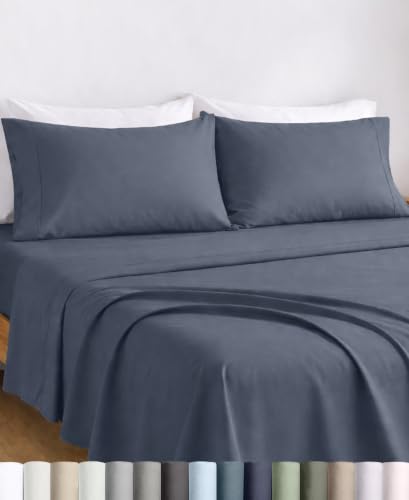
OUR SHEET SET HAS EARNED THE GOOD HOUSEKEEPING SEAL - Luxury 100% Egyptian Cotton Sheets: This lightweight percale sheets king size sets are DNA-tested and certified with the Gold Seal by the Egyptian Cotton Association. Complete your bedding ensemble with this king sheet set.
How Yarn Quality Beats Thread Count for Preventing Pilling
How exactly do you spot sheets that’ll stay smooth for years? You’ll want to look past thread count and focus on yarn quality instead. High thread count won’t save short-staple cotton from pilling propensity—you need long-staple cotton with superior fibre length.
You should seek combed yarns, where manufacturers remove the shortest fibers before spinning. This reduces loose hairs that catch and knot, lowering pilling risk dramatically. A well-balanced fabric twist keeps yarn compact, preventing fibers from breaking and bobbling on the surface.
You’ll notice percale demonstrates this principle well: its tight, uniform construction relies on quality long-staple, combed yarns that resist pilling better than loose, uneven alternatives. Remember, yarn quality and fibre length outweigh thread count every time when you’re predicting how long your sheets stay smooth.
Recommended Products

Luxury Cotton Sheets Set: Our 600 thread count 100% cotton smooth sateen sheets are naturally soft breathable and thick,providing you with a luxurious hotel experience at home. Crafted from premium Supima Cotton, our bedsheets set is ultra-durable.Simple&Opulence is committed to providing you with high-quality bedding set to ensure a comfortable sleep all year long.

Luxury Cotton Sheets Set: Our 600 thread count 100% cotton smooth sateen sheets are naturally soft breathable and thick,providing you with a luxurious hotel experience at home. Crafted from premium Supima Cotton, our bedsheets set is ultra-durable.Simple&Opulence is committed to providing you with high-quality bedding set to ensure a comfortable sleep all year long.

Luxury Cotton Sheets Set: Our 600 thread count 100% cotton smooth sateen sheets are naturally soft breathable and thick,providing you with a luxurious hotel experience at home. Crafted from premium Supima Cotton, our bedsheets set is ultra-durable.Simple&Opulence is committed to providing you with high-quality bedding set to ensure a comfortable sleep all year long.
Percale vs Sateen: Which Weave Pills Less?
When you’re weighing percale against sateen, you’re really comparing two fundamentally different approaches to fabric structure. Percale uses a tight one-up-one-down weave that limits exposed fiber ends, giving it stronger pill resistance. Sateen floats yarns across the surface for smoothness, but those same floats abrade more easily and invite pilling on lower-quality finished fabric.
Don’t rely on weave alone. Fiber length shapes pilling propensity more than pattern does. You’ll cut pilling risk dramatically by prioritizing long-staple cotton and combed yarns, whatever weave you pick. Fine percale stays matte and orderly; quality sateen drapes beautifully but sheds pills if its yarns aren’t tightly controlled. Choose your weave based on fiber quality and finish rather than thread count alone.
Recommended Products


1 Fitted sheet (60” x 80” + 15”)

100% COTTON FITTED SHEET. 100% Cotton Percale Weave Full Fitted Sheet brings the crispiness and longevity that is comparable to prestigious hotel. The sheets are weaved using high quality Long-Staple Combed Cotton yarns in India, to make it the valued crispy percale 200 TC sheets in the industry. Varied colors to match your solid or printed duvet, quilt or comforter set in white, ivory, sage, taupe, dark blue (navy blue), baby blue, silver, and charcoal.
What Sheet Finishes Prevent Pilling (And How to Spot Them)
Why do some sheets stay smooth while others turn into fuzz? You can spot the difference in fabric finishes. Mills use enzyme biopolishing to dissolve protruding cotton fiber fuzz before it tangles into pilling. Mercerisation swells and tightens long-staple cotton, creating a harder, smoother surface that resists friction. Post-weave tidying—controlling micro hairs through singeing or surface treatment—removes the loose ends that anchor pills. You want even finish quality: hold sheets to light and check for a halo of fluff. Clean faces mean fewer nibs to knot up. Skip sheets with visible surface fuzz; consistent surface treatment signals mills invested in preventing pilling from day one.
Recommended Products
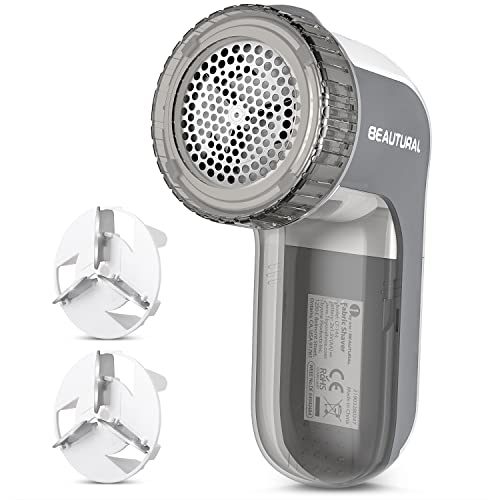
Easily remove lint, fluff, fuzz balls and bobbles from your favorite garments and fabrics

LCD Screen & 3-Speed Settings: The Ziitty electric lint remover features an LCD display showing the battery level and speed; press the power button to switch speed easily. The 3-speed setting fits different fabrics — Low for cashmere & silk, Medium for cotton & knitwear, High for wool & coats — so it meets daily needs on sweaters, sofas, blankets, curtains and more

Adjustable 3-Speed Precision - Featuring three adjustable speed settings, this lint remover adapts to delicate fabrics, thicker garments, and durable upholstery with ease. Say goodbye to pilling, fuzz, and lint without damaging the fabric.
Washing Habits That Cause Pilling in the Drum
Even the best mill finish can’t withstand a beating in the wash. You’re accelerating pilling when you overfill the drum, cramming your sheets together so fibres can’t slide freely. That tight packing creates brutal friction, wearing fibres down faster than any gentle cycle would.
You compound the damage by mixing sheets with rough garments—denim, zippers, and Velcro act like sandpaper against delicate fibres. Skip the aggressive cycle; those violent spins batter your sheets unnecessarily. You’re also weakening fibres when you choose hot water or max spin speeds, roughening surfaces and inviting pills to form.
Turn your sheets inside out and wash them separately to protect outer surfaces.
And ditch the fabric softener—it coats fibres, trapping debris that increases abrasion during tumbling.
Recommended Products
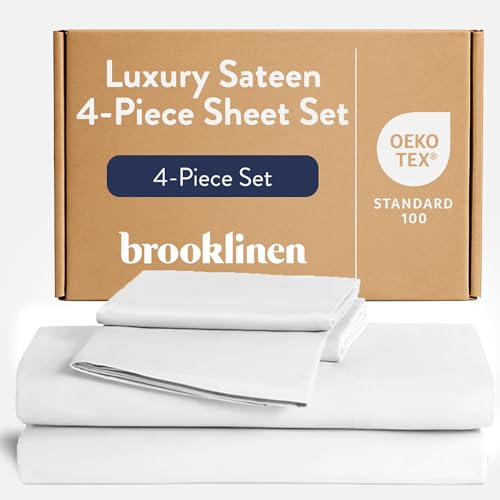
LUXURY SATEEN 4-PIECE SHEET SET: Featuring a rich, buttery-smooth weave, our best-selling Luxe Sateen Sheets are the ultimate bedding upgrade. Perfect for elevating your sheet game, these bed sheets feature a luxurious 480 thread count and a slightly luminous finish. Start styling your bed with the Core Sheet Set, which includes 1 fitted sheet, 1 flat sheet, and 2 pillowcases.

GOTS CERTIFIED ORGANIC COTTON: Doz by SIJO Cotton Sheets are made with naturally grown long staple organic cotton fibers and GOTS Organic Certified by IDFL 018832. Our sheets are also Oeko Tex 100 Class 1 certified with the strictest requirements that are for baby apparels. Our organic cotton sheets are made with none toxins at every step, you can sleep soundly knowing that 100% of our sheets are free from harmful chemicals, pesticides and GMOs.

Winner Oprah Daily Sleep Award 2026 - Restful Retreat Sateen Sheet: Our 600 thread count king cotton sheet set brings a balance of comfort and refinement. Made with single-ply 100% long-staple cotton, this weave offers a balanced feel between thickness and lightness. High-quality smoothness with a subtle luminous soft sheen. Independently tested to earn the prestigious Good Housekeeping Seal.
How Your Detergent and Water Hardness Damage Sheet Fibres
How exactly does your detergent sabotage your sheets? You disturb cotton fibers when you use too much or too little detergent. Too little leaves soil that abrades; too much leaves stiff residue that roughens the fabric surface, accelerating pilling. You compound this damage when you ignore your water hardness. Hard minerals interact with detergents, forming deposits that roughen fabric surfaces further. You counteract this with an extra rinse to restore crispness.
You’re stressing fibers with high heat when warm water suffices. Gentle washing protects cotton fibers better than aggressive cycles. You skip fabric maintenance at your peril—run a monthly machine cycle to remove scale and film that trap particles. You’re cautious with softeners; they coat fibers and mask proper cleaning. You choose biological detergents for deeper low-temperature cleaning, or fragrance-free non-bio for sensitive skin. You follow care labels precisely.
Recommended Products

Luxurious Egyptian Cotton: Sweave’s Cotton Percale Sheets are crafted from 100% Egyptian Cotton, highest quality cotton in the world. These Percale Cotton Sheets stand out due to their superior durability and luxurious texture, which is attributed to their exceptionally long fibers. Opting for these Percale Sheets provides a noticeable upgrade in terms of both comfort and quality.

CHOOSE THIS IF YOU LOVE CRISP, COOL FEEL 100% ORGANIC COTTON QUEEN SHEET SET: Percale is a classic woven cotton weave with a distinctly crisp, cool feel and matte finish — like a freshly pressed dress shirt, and NOT a silky or smooth sateen weave. It continues to stay crisp and gets softer with every regular wash. Not for sleepers expecting smooth, or silky sheets with sheen— made for those who love the cool, airy feel of true cotton percale.
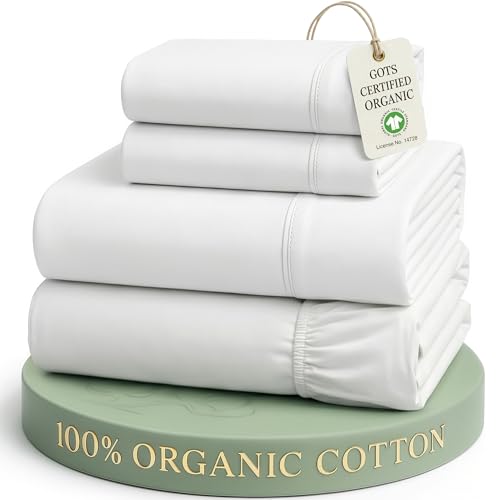
Naturally Cooling Organic Comfort : Stay cool and comfortable with Lane Linen 100% Organic Cotton Percale King Sheets, made from GOTS Certified organic cotton. The crisp percale weave and finer yarns create a lightweight, breathable feel that promotes airflow and balanced temperature for year-round comfort. Gets softer and smoother with every wash. Great as deep pocket King sheets, a cooling King sheet set, and breathable King size bed sheets.
Why Sheet Fit and Rotation Control Pilling
Where exactly do your sheets wear out first? You’ll notice strained corners and thinning zones where constant contact occurs. Poor sheet fit aggravates this problem directly. When your fitted sheets lack proper depth or secure holds, they shift during sleep, creating excess friction against your body and mattress. That friction grinds fibers together, accelerating fiber breakage and pilling.
Intelligent rotation transforms your bedding’s lifespan. By cycling two or three sets weekly, you improve wear distribution dramatically. You’re not abusing the same long-staple cotton surfaces nightly, so fibers recover between uses.
Pair your set with a duvet cover to shield top surfaces from direct abrasion during lounging or sleeping. This simple shielding maintains smooth drape and reduces surface destruction. You’ll cut pilling significantly through these combined protective habits.
Recommended Products

【WORLD'S FINEST COTTONS】Not all cottons are created equal. Supima cotton is a superior type of cotton grown in the USA. It represents less than 1% of cotton grown in the world. What makes Supima unique to other cottons is the extra-long staple fiber that gives the cotton its premium properties: Strength, Softness and Color retention. Supima is superior to Egyptian cotton and pima cotton.

【WORLD'S FINEST COTTONS】Not all cottons are created equal. Supima cotton is a superior type of cotton grown in the USA. It represents less than 1% of cotton grown in the world. What makes Supima unique to other cottons is the extra-long staple fiber that gives the cotton its premium properties: Strength, Softness and Color retention. Supima is superior to Egyptian cotton and pima cotton.
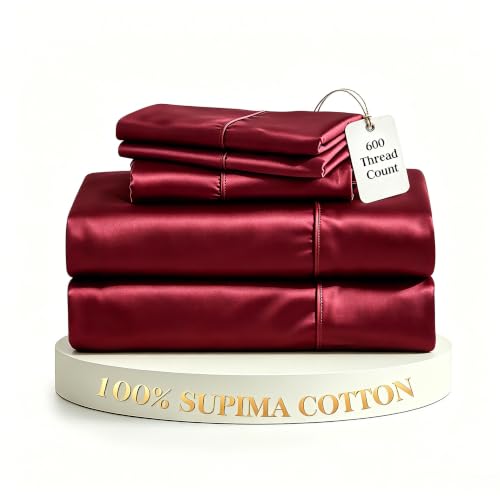
Luxury Cotton Sheets Set: Our 600 thread count 100% cotton smooth sateen sheets are naturally soft breathable and thick,providing you with a luxurious hotel experience at home. Crafted from premium Supima Cotton, our bedsheets set is ultra-durable.Simple&Opulence is committed to providing you with high-quality bedding set to ensure a comfortable sleep all year long.
How to Remove Pilling Without Damaging Your Sheets
Once you’ve slowed pilling through proper fit and rotation, you’ll still need to address existing damage.
For pilling removal, lay your sheets flat and run a fabric shaver slowly across the surface, keeping away from seams to protect cotton fibers. You’ll get clean results without adding friction that creates new pills.
If you don’t own a shaver, you can try the razor method—drag a disposable blade lightly to lift pills, but take care not to slice the threads.
Skip pumice stones and hot water; heat won’t dissolve pills and weakens fabric instead.
After treatment, switch to long-staple cotton and stick to a gentle wash cycle. You’ll cut wear dramatically and adopt care to slow recurrence.
Recommended Products

LUXURY, BREATHABLE & COMFORTABLE: Crafted from 100% Long-Staple Combed Cotton Sateen Weave, this densely thick 1000-thread count king-size pillow case is made with specially compacted yarn. Minimal artificial processing makes this pillowcase gentle on all skin types, prevents night sweats, absorbs moisture and regulates body temperature with its heavy texture, ensuring a cool sleep experience while maintaining the royal hotel look.

CONTENTS AND MEASUREMENT: 100% cotton and 63" wide Muslin fabrics, This fabric has a smooth finish, with a soft touch. It also has a natural light drape and stiffness, thanks to its cotton content. ( when order QTY= 2, means you will receive 2 separate pack)
Conclusion
You can prevent pilling by choosing long-staple cotton with a tight percale weave and combed yarns. Wash gently in cool water, skip the fabric softener, and don’t overload your drum. Rotate fitted sheets regularly and ensure proper fit to reduce friction. If pills appear, shave them off carefully. Your sheets will stay smoother far longer when you match quality construction with mindful care from day one.
Recommended Products

【Portable Fabric Shaver】-- Special designed for removing fuzz, pills, and lint from sweaters, blankets, curtains, carpets, furniture, couch, and more; compact and portable, 2.4x2.3x6inch, great for home use or travel to keep your garments looking pristine

FABRIC DE-FUZZER: Your go-to fabric shaver, the battery-operated and portable-power Conair Fabric Shaver safely removes fuzz, lint, and pills from your favorite fabrics. From socks to sofas, this lint shaver is safe for use on most household fabrics.

Upgraded 6-Blade System for Maximum Efficiency: Experience professional-grade fabric renewal. The upgraded 6-leaf stainless steel blades, combined with a powerful motor offering two speed settings (up to 9,000 RPM), efficiently remove pills, fuzz, and lint from clothing and furniture in seconds, restoring fabrics to a smooth finish