

You’ve probably stood in the curtain aisle, overwhelmed by number after number on every package. The chart looks straightforward—widths from 24″ to 150″, lengths climbing from 63″ to 144″—but you’re not sure which combination actually works for your window. Getting this wrong means gaps where light leaks through or fabric that pools awkwardly on your floor. Before you grab the nearest “standard” size, there’s a calculation you need to make first.
Key Takeaways
- Curtain sizes are listed as width × length, with 52″ × 84″ being a common standard.
- Standard widths range from 24″ to 150″ to fit narrow windows through wall-to-wall openings.
- Standard lengths span 63″ to 144″, matching 8-foot to 12-foot ceilings.
- Multiply rod width by 2× to 2.5× for proper panel fullness and coverage.
- Add 3–6 inches beyond window sides and mount rods 4–6 inches above frames.
Recommended Products
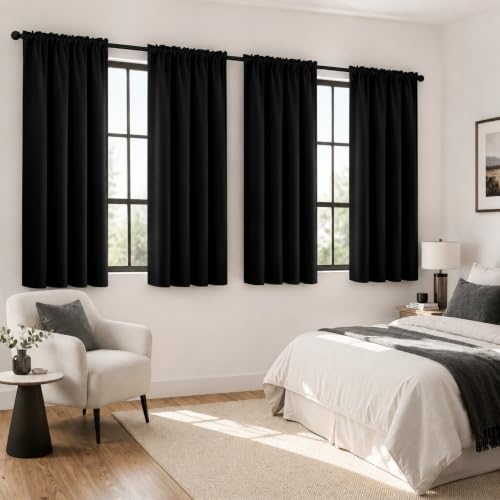
Package Includes & Material: Each package includes 4 black blackout curtains, each measuring 54 inches in length and 40 inches in width, with a total width of 160 inches for the 4 curtains. The 4-piece set provides fuller pleats and wider coverage, which is usually more cost-effective than purchasing two separate 2-piece sets. These curtains are the same colour on both sides. Made from thick 225 GSM matte single-layer fabric, these curtains drape neatly, creating a clean, modern look

Package Includes: Sold as Pair, Set of 2 farmhouse kitchen curtains. Each small curtain is 42 inch wide by 54 inch length. Constructed with 1.5" header and 2" rod pocket which works well with tension rods or normal rods, easy to install and slide. Ideal layering piece for added privacy and light control
Standard Curtain Sizes Chart: How to Read Widths and Lengths
Ever wonder why your curtains look awkward even when you’ve measured twice? You’re probably reading the size chart wrong. Don’t worry—you’ll fix this now.
When you see “52 × 84″ on a package, you’re looking at width first, then length. The width (52″) covers your window’s horizontal span; the length (84”) hangs from rod to floor. You multiply the width by your desired fullness—typically 2× to 2.5× your window width—so you’ll need multiple panels.
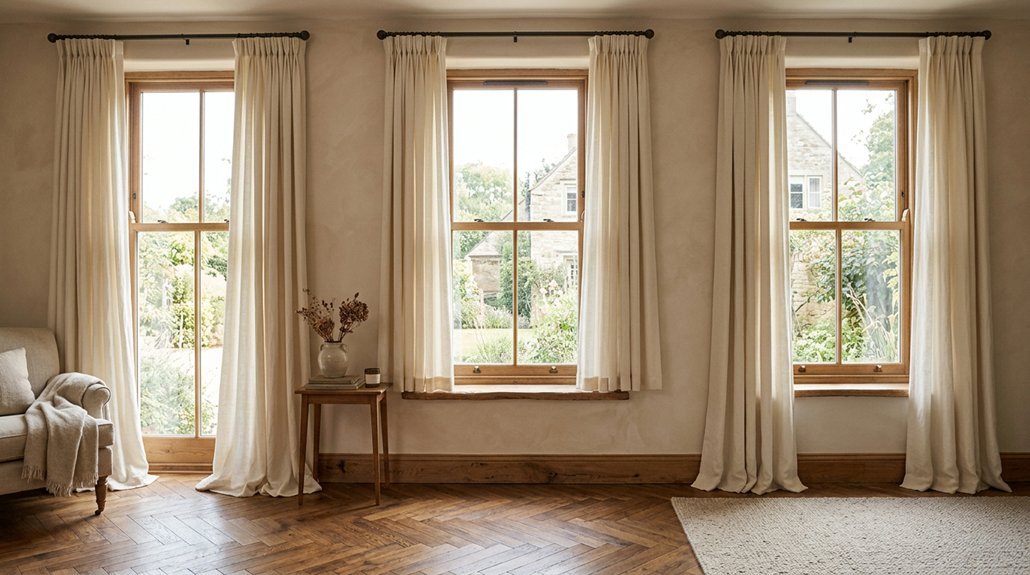
Check your rod placement before you buy. Mount it 4–6 inches above the window frame and extend 3–6 inches beyond each side. You’ll measure from that rod to where you want curtains to fall—windowsill, apron, floor, or puddle.
Now you’re reading charts like a pro.
Recommended Products

100% Blackout Curtains: A full blackout white coating is attached to the back of our linen curtains, blocking 100% of sunlight and UV rays. Provide you a complete private and personal space for a sweet sleep or rest. Good choice for bedrooms, nursery, living rooms, offices, patio door. Also perfect for babies, night shift workers and people sensitive to light

Pair Sold: Each package includes 2 panels of blackout curtains. Each panel measures 40"W x 84"L, with a pair measuring 80"W x 84"L. Each panel has 6 anti-rust silver grommets(1.6 inch inner diameter) which would fit most standard curtain rods

Ready Made: Each package includes sheer curtains 84 inch length 2 panels set, total width is 80". The top dual rod pocket are between 1.5"-2" in size, suitable for curtain rods of most windows, which make curtains easier to hang and slide.
Curtain Widths Explained: 24″ to 150″ Options
Now that you’ve nailed how to read size charts, let’s look at what those width numbers actually mean for your windows. Curtain widths span from 24″ to 150″, and you’ll match these to your window’s fullness needs.
You’ll find 24″ to 50″ panels suit narrow windows, side lights, and small accents. Standard windows call for 54″ to 84″ widths, giving you that classic 2x fullness ratio. For wider windows or sliding doors, grab 96″ to 120″ panels. The max 150″ options cover expansive openings and wall-to-wall installations.
Remember: you need total panel width to equal roughly double your rod length. Two 54″ panels equal 108″—perfect for a 54″ rod. Don’t skimp; skimpy curtains look cheap. Measure twice, account for overlap, and you’ll nail the gathered, professional look every time.
Curtain Lengths by Ceiling Height: 63″ to 144″ Guide
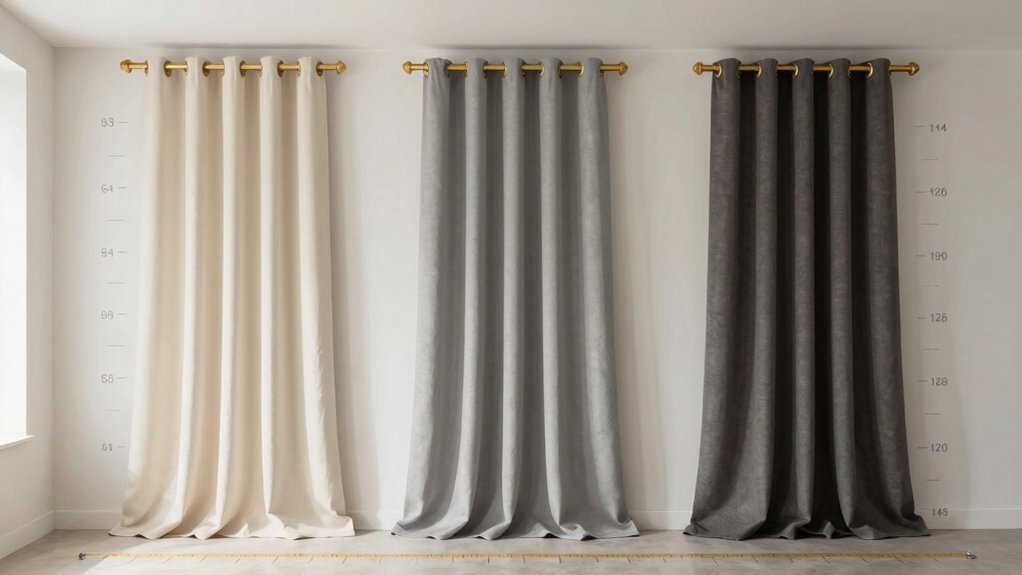
How do you choose the right curtain length when options range from 63″ to 144″?
You’ll match length to ceiling height for balanced proportions. With standard 8-foot ceilings, you’ll select 84″ or 96″ panels. The 84″ option skims just below the sill; 96″ drapes to the floor.
For 9-foot ceilings, you’ll hang 108″ curtains. They’ll pool slightly or hover above the floor depending on rod placement.
Ten-foot ceilings demand 120″ or 128″ lengths. You’ll mount rods closer to the ceiling to emphasize vertical space.
Twelve-foot ceilings require 144″ panels for proper scale. You’ll avoid anything shorter— it’ll look stubby and out of proportion.
Remember: you’ll measure from rod to floor, not window frame to floor. Add 2-4 inches if you prefer a puddled effect.
Recommended Products

2-Pack Integrated Curtain Rod Wall Bracket Set: includes 2 black shelving brackets for floating with built-in curtain rod holder, also works as window drapery rod hanger; This matched pair of shelft brackets provides balanced support for single small floating shelf installation, while the curved loop acts as an independent rod bracket for wall to add extra hanging space under the storage board

Adjustable length: 32-57" curtain rod fits windows 24 to 49 inches wide. It's telescoping rod extends up to 9", and the adjustable thickened brackets allow the gap between the rod and wall to be adjusted from 2.5 to 3.5", preventing friction and enhancing light-blocking performance.(Important Note: To ensure safe shipping, this rod consists of 3 segments that require assembly. It is not a single or 2-piece pole.)

【ADJUSTABLE LENGTH】Composed of 5/8 diameter curtain rods, the small curtain rod is ranging from 30 to 90 inches in length, suitable for windows ranging from 30 to 84 inches. Each set comes with 6 rods that need to be screwed together, not 2 poles
What Size Curtains for Your Window Type?
Where should you start when matching curtains to your window? You begin by identifying your window type, as each demands specific curtain dimensions.
You’ve got standard single windows, which typically use panels measuring 25 to 50 inches wide. You’ll hang these either to the frame’s edge or beyond it for fullness.
Double windows or sliding glass doors require wider panels—often 72 to 100 inches each—or multiple standard panels. You’ll need enough fabric to cover the expanded span without looking stretched.
Bay and corner windows challenge you with angled frames. You’ll select flexible rod systems and multiple narrower panels that follow each section’s contour.
For picture windows, you usually choose longer, wider panels that extend well past the glass edges. You’ll maximize both coverage and visual impact.
Arched windows need careful attention: you’ll use rod pockets or rings mounted below the curve, or you’ll invest in custom shapes that follow the arch itself.
Recommended Products

READY MADE: 2 Linen Curtain Panels per package.Each panel measures 52 inches wide by 96 inches long. Top design of Back tab & loop pocket provide 3 hanging options. <1> hanging from the back patch to create an elegant pleated look, <2> from the 3 inch rod pocket for a classic look <3> Hanging with clip rings for easy, slide open and closed (clip rings are not included)
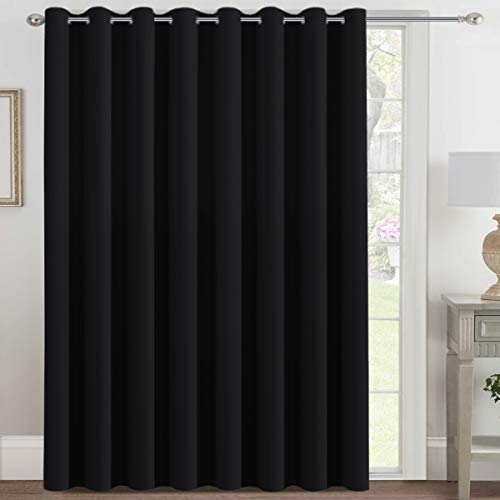
Large Size: Sold per single panel, measures: 100 inch width by 96 inch length (8ft Tall by 8.5ft Wide), Each panel has 16 strong metal grommets (rim of grommet is 2.4", while inner is 1.6") can be hung from a basic or decorative curtain rod

Large Size: Sold per single panel, measures: 100 inch width by 96 inch length (8ft Tall by 8.5ft Wide), Each panel has 16 strong metal grommets (rim of grommet is 2.4", while inner is 1.6") can be hung from a basic or decorative curtain rod
How to Measure Windows for Curtains: Step-by-Step
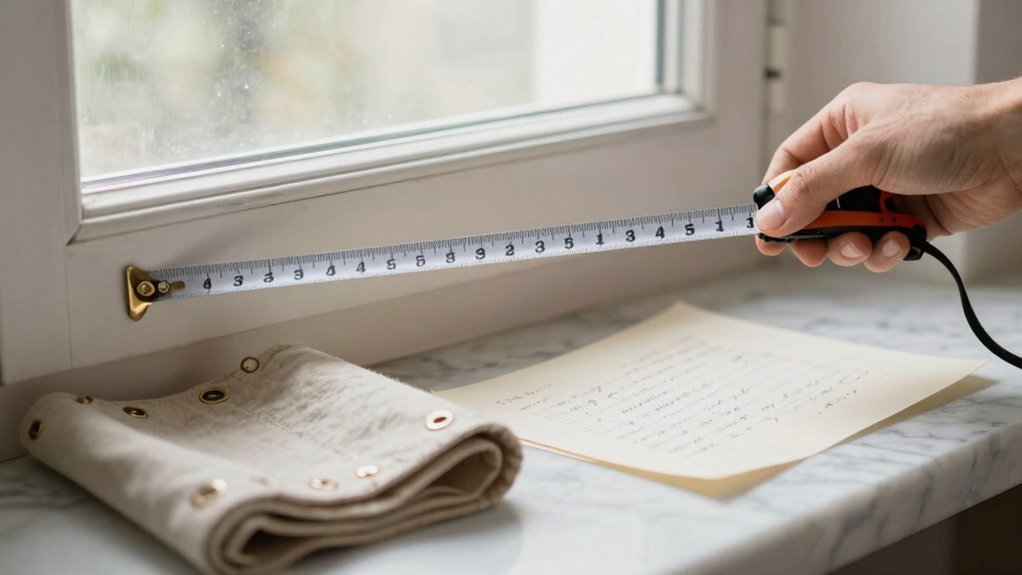
Why guess when precision takes just minutes? Grab your steel tape measure and let’s get started.
First, measure the width. Stretch your tape across the window frame from edge to edge. Write that number down. Now measure the height the same way, from top sill to bottom sill.
Next, decide where you’ll mount the rod. Mark your desired height above the window—typically 4–6 inches higher, or even up to the ceiling for drama. Measure from that mark to where you want curtains to fall: the sill, below the sill, or the floor.
Add 1–2 inches to each side of your width measurement for minimal stack-back, or more if you want broader coverage. These numbers guide your shopping. You’ll match them against standard curtain sizes and select panels that fit your exact setup.
Recommended Products
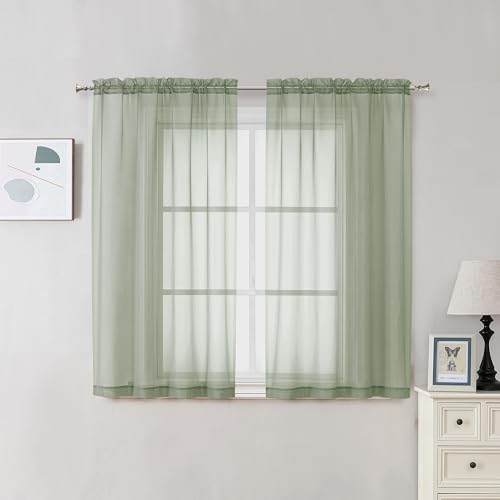
Well Made: Sold as 2 panels sheer curtains per package, each panel measures 42" wide by 54" long, not only wider than ordinary 38" width, but also affordable cost than other extra wide sheer curtains, the size will allow these panels to decorate sufficiently over your windows.
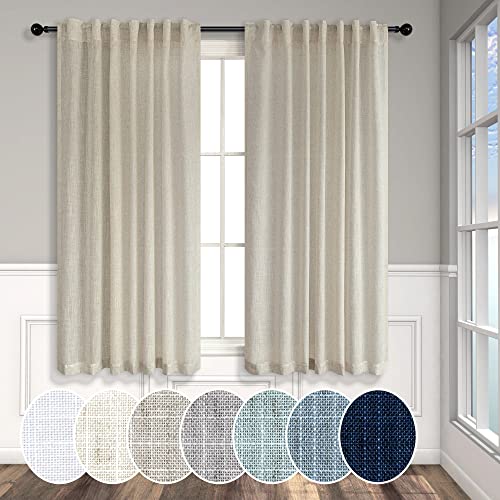
Basic Information: 2 LINEN PANELS in 1 package. Each panel measures width 52 x 54 length. 3-Way Hanging Options: Hang these curtain panels (1) using the back loops to create an elegant pleated effect, (2) from the 3 inch rod pocket for a classic look, or (3) using clip rings for easy, slide open and closed (clip rings are not included)

✅ EXACT RIGHT SIZE FOR YOUR WINDOWS - 1 Pair of 2 Standard Length 54" x 84" Dusty Blue (Slate) Sheer Curtains. Total Width - 108". 2 Voile Grommet Curtain Panels are Included In Each Package. 16 Grommets Total, Each Grommet Can Fit a Rod Up To 1.5 Inch in Diameter.
Curtain Fullness Calculator: Width Multipliers Simplified
When you’re hanging curtains, the fabric needs to gather, ripple, and fold—not hang flat like a sheet. That’s where width multipliers come in. You’ll multiply your rod width by a specific number to achieve the right fullness.
For standard pencil pleats, you’ll multiply by 2.0. Eyelet headings need 1.5 to 2.0 times the width. Pinch pleats require less fabric at 2.0 to 2.5 times. Sheer fabrics demand more volume, so you’ll use 2.5 to 3.0.
Here’s your quick formula: measure your rod width, choose your heading style, apply the multiplier, and divide by the panel count. You’re calculating total fabric width needed. Always round up to the nearest standard curtain width. If you’re between sizes, go larger—extra fullness looks luxurious, but skimpy panels look cheap.
Recommended Products
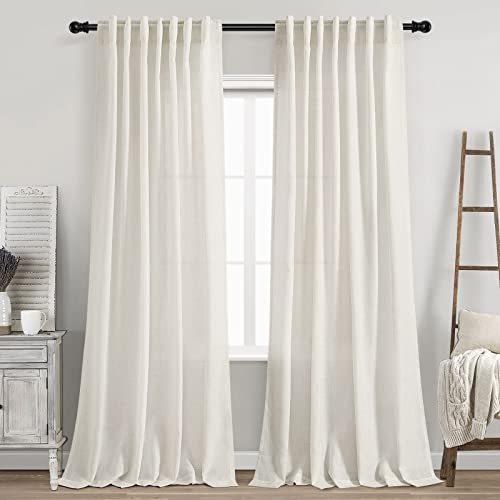
READY MADE: 2 Linen Curtain Panels per package.Each panel measures 52 inches wide by 84 inches long. Top design of Back tab & loop pocket provide 3 hanging options. <1> hanging from the back patch to create an elegant pleated look, <2> from the 3 inch rod pocket for a classic look <3> Hanging with clip rings for easy, slide open and closed (clip rings are not included)
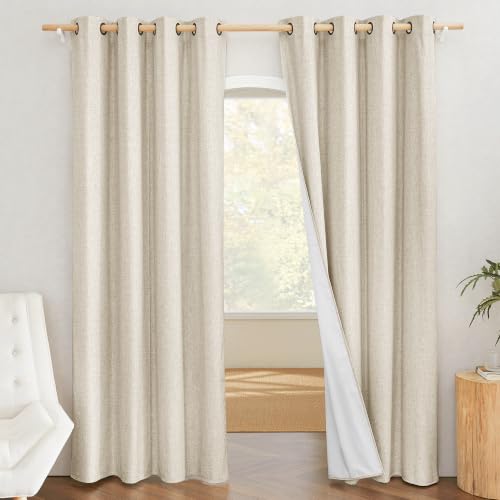
100% blackout design blocks all light for restful sleep

Pair Sold: Each package includes 2 panels of black blackout curtains. Each panel measures 40"W x 84"L, with a pair measuring 80"W x 84"L. The black thermal insulated curtains have 2 hanging options (Rod pocket & Clip Style) with a 3-inch rod pocket to fit 1.5-inch rods. Multiple colors and sizes are available to meet your preferences
Non-Standard Curtain Sizes: Cafe, Extra-Long, and Custom
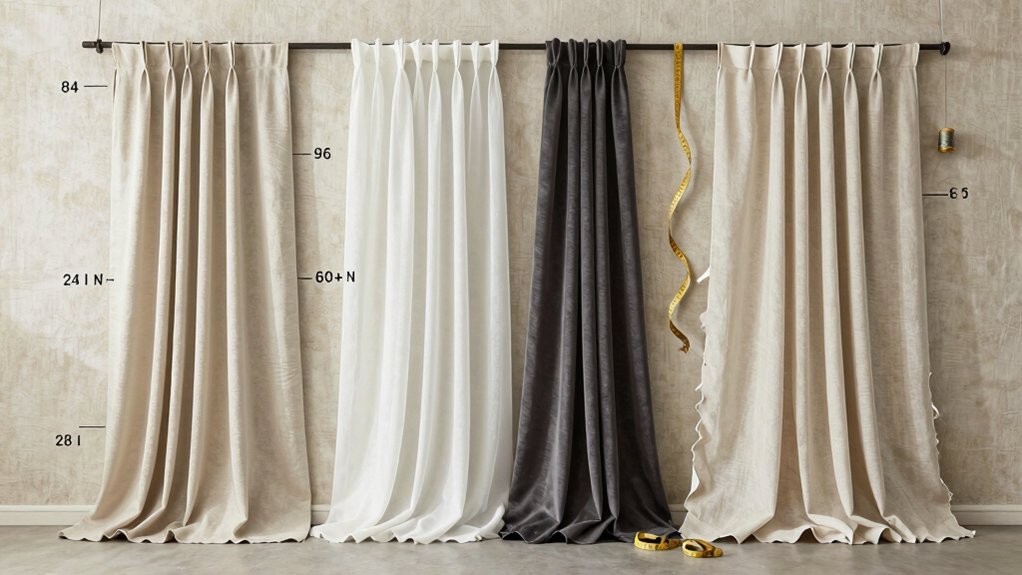
Sometimes the standard sizes just won’t cut it for your windows. You need options that break the mold.
Cafe curtains cover only the bottom half of your window, perfect for kitchens or bathrooms where you want privacy with light. You’ll find these in 24- or 36-inch lengths, but measure carefully—your window height dictates your choice.
Extra-long curtains suit tall ceilings and dramatic spaces. You can source panels reaching 108, 120, even 144 inches. Check your floor-to-ceiling measurement twice before ordering.
Custom sizing solves everything else. You provide exact dimensions, and fabricators cut and sew to your specifications. This costs more, but you’ll get the fit you need for odd-sized windows or specific design visions. Always request fabric samples first.
Recommended Products

The Bella drapes are solid panels on a linen look ground fabric, constructed as a semi-sheer light filtering

Forest Hill panels offer a contemporary branch motif on a linen look woven blackout fabric

Package Include: Set of 2 velvet curtain panels with tiebacks of the same color and material. Each panel measures 52 inch width x 63 inch length
Common Sizing Mistakes and How to Fix Them
How often do you hang curtains only to realize they look off? You probably measured the window but forgot the rod placement. Mount rods four to six inches above the frame and extend past the sides—this prevents that awkward “floating” look.
You buy panels that exactly match your window width, right? Don’t. Multiply your window width by two or two-and-a-half for proper fullness. Skimping creates flat, lifeless drapes.
You ignore puddling length? Stop. Floor-length curtains need one to three extra inches for elegance; café curtains must clear sills completely.
You forget hardware bulk? Add those inches to your length measurements.
You can fix most mistakes with simple adjustments: lower or raise rods, add clip rings, or sew a quick hem. Measure twice, hang once—your windows deserve better.
Recommended Products

WIDE POCKET DESIGN WITH DURABLE METAL SUPPORT: 2.5 inch pocket fits wide pocket drapery securely, while adjustable 3.44"–5.94" projection allows flexible spacing and sturdy metal construction ensures reliable support.

Timeless Design: The 7/16 inch diameter Interior Living Adjustable Petite Café Curtain Rod combines style with function and is the perfect accent to lightweight Café Curtains, Valances, or Tiers on smaller windows in the home

【📏Curtain Rods for Windows 18 to 45 inch(1.5-3.75ft)】 18''-45'' Curtain Rods Package Includes: 2 x Finials, 2 x 16" x 5/8" Fixed Rods, 1 x 16" x 1/2" Adjustable Rods, 2 x Brackets, 1 x Connector, 4 x Anchors, 4 x Screws, and an Installation Instructions. Curtain rods can extend from 18 inches to 45 inches, choose the right size curtain rod according to the length of your window. Our curtain rods are available in three sizes for your choice: 18''-45'', 36''-88'', 36''-120''.
Where to Find Hard-to-Find Curtain Sizes
What do you do when standard sizes won’t cover your window? You search beyond big-box retailers. You browse custom curtain shops online—they’ll cut panels to your exact measurements. You contact local seamstresses or tailors; they’ll craft bespoke treatments that fit perfectly. You explore specialty home décor boutiques that stock oversized or extra-narrow options others ignore. You check European retailers if you need longer drops than American standards allow. You investigate DIY solutions, buying fabric by the yard and adding clip rings. You request quotes from interior designers’ trade sources, which often access extended sizes. You verify return policies before ordering, since custom work rarely ships back. You’ll find what you need when you look past conventional shelves.
Recommended Products

WELL MADE: Each pack contains one (1) blackout functional double wide curtain panel. Panel mesures 100"W x 96"L(8.3'W x 8'L side-to-side include 1.2-inch top measurement), we recommend curtains 1.5 to 2 times the width for optimal hanging effect. Thread trimmed and wrinkle free, constructed with 16 anti rust grommets top, fit well up to 1 1/2 inches curtain rods. As the fabric is heavy, please consider the weight-bearing capacity of the curtain rod in advance.

SET DETAILS: Pack of single room divider panel curtain, measures 8.3 Foot wide by 8 Foot long with 14 silver metal grommets (1.6 inch inner diameter) on top, easy to install and slide smoothly.

HUMMINGBIRD DESIGN:Allow this charming and whimsical Hummingbird Paradise Window Curtains Panels Set to ease your mind and also inspire it. The drapes are perfect for vintage farmhouse style room and anyone who wants to add a touch of nature. These look fabulous in living room, bedroom, nursery, kitchen, bathroom and rv
Conclusion
Now you’ve got the full picture for choosing curtains that fit your windows perfectly. Measure your rod width and height first, then multiply by 2–2.5× for fullness. Check standard sizes before going custom, and don’t forget to account for rod placement and mounting height. With this chart in hand, you’ll avoid common mistakes and find panels that look polished and proportional in any room.