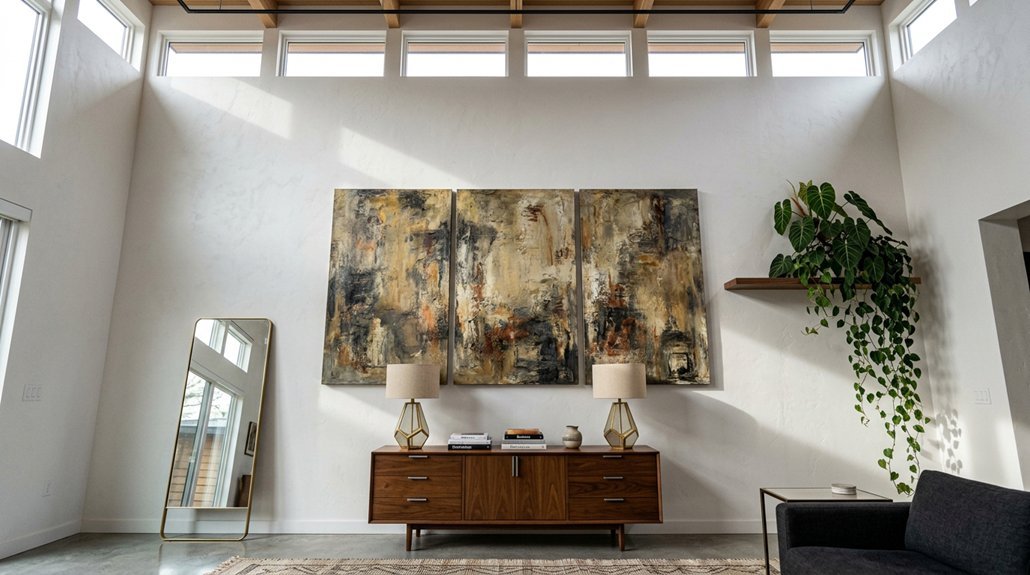

You’ve arranged your space with care, yet one blank wall disrupts the composition. You need that final piece anchored precisely, but steel penetrating plaster feels too permanent, too brutal for something you might reposition. The solution lies in methods that respect both your walls and your evolving aesthetic—techniques that distribute weight intelligently across surfaces without surrendering to the hammer. What follows transforms limitation into opportunity.
Start With Adhesive Hooks: Hang Lightweight Art Without Nails
Where might one begin when walls must remain pristine yet crave adornment? You anchor lightweight art with adhesive hooks, those ingenious strips that suspend beauty without marring surfaces.
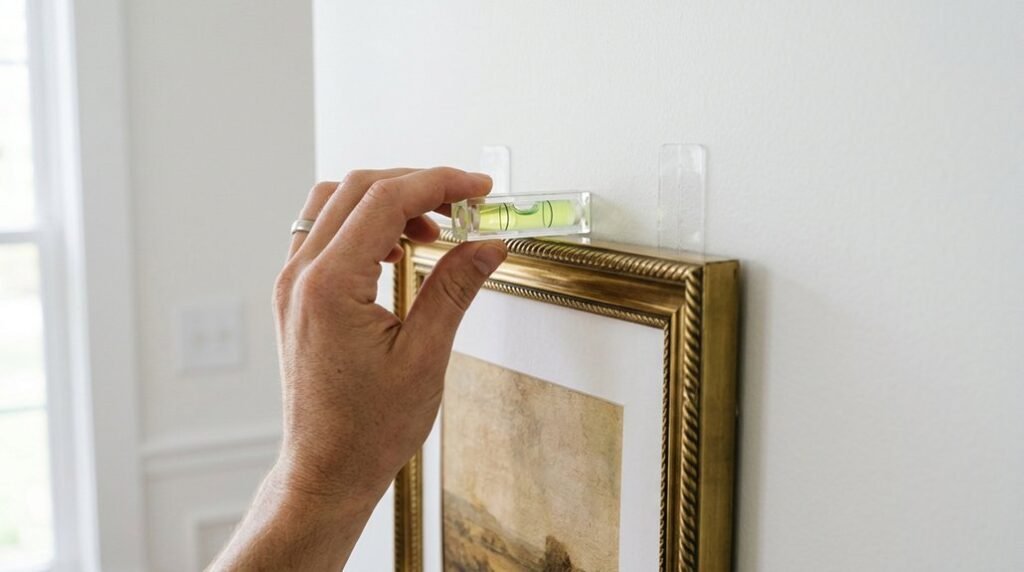
First, you cleanse your chosen expanse with isopropyl alcohol, removing invisible barriers between adhesive and wall. You press the hook firmly, yielding to temporal patience—one hour minimum—before permitting your piece its aerial debut.
Heed weight limits scrupulously; manufacturers stipulate capacities, often sixteen pounds per set for premium varieties. Exceed these thresholds, and gravity asserts its merciless jurisdiction. For substantial framed prints or dimensional canvases, distribute demands across multiple hooks, distributing load across broader surface area.
You’ve orchestrated vertical elegance without perforation, preserving architectural integrity while fulfilling your curatorial vision. Adhesive solutions reward meticulous preparation with enduring, invisible support.
Recommended Products

Premium Materials & Durable Construction: DDMY Adhesive hooks crafted from robust stainless steel and durable PVC; high quality and longevity; remain clean and unaffected by time; non-toxic, recyclable, and transparent

【Heavy Duty Adhesive Wall Hooks & Multi-Scene Use】These 13lb load-bearing hooks are ideal for towels, coats, keys, plants and bathroom supplies. Widely used in home, kitchen, bathroom and garage. 12 Pack included

HOLDS UP TO 4 POUNDS: One package of the white Command Sawtooth Picture Hangers includes four picture frame hangers and eight large Command Strips; one adhesive picture hanger holds up to 4 lbs
Protect Your Paint: What “Damage-Free” Actually Means
Adhesive hooks promise an immaculate separation from your wall, yet that “damage-free” label warrants closer scrutiny than most renters afford it.
You’ll scrutinize surface preparation meticulously—wiping with isopropyl alcohol eliminates residue that compromises adhesive strips’ integrity.
Press firmly; wait sixty minutes before suspending your piece.
This temporal patience ensures molecular bonding achieves full tensile strength.
Exceeding the weight rating courts catastrophe: peeling paint, exposed drywall, compromised aesthetics.
Verify compatibility with your wall’s texture and sheen—matte surfaces behave differently than semi-gloss.
Manufacturers delineate precise parameters; you’ll honor them scrupulously.
True damage-free suspension demands disciplined adherence to protocols, not merely wishful interpretation of packaging promises.
Your wall’s immaculate surface depends upon this precision, this reverence for material limitations.
Recommended Products

HOLDS UP TO 0.5 POUNDS: One package of the Command Clear Small Wire Toggle Hooks includes 10 wall hooks and 12 adhesive strips; each adhesive wall hook can hold up to 0.5 pounds

HANGS UP TO 19 ITEMS: One Command Variety Pack includes six small picture hanging strips, four large picture hanging strips, three medium utility hooks, two large utility hooks, three small utility hooks, six small wire hooks and 20 strips
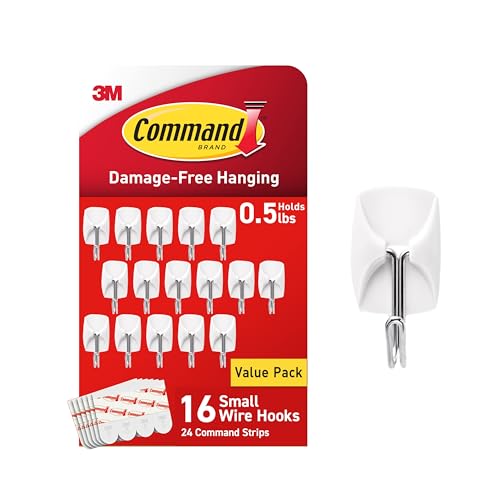
HOLDS UP TO 0.5 POUNDS: One package of the Command White Small Wire Toggle Hooks includes 16 wall hooks and 24 adhesive strips and a metal wire toggle feature for versatile hanging; each adhesive wall hook can hold up to 0.5 pounds
Upgrade to Picture Rails for Heavy Art Without Wall Damage
Though adhesive solutions falter beneath substantial weight, you’ll find enduring elegance in the architectural tradition of picture rails—those slender moldings that crown your walls like a curator’s final gesture, suspending substantial works through braided cords or slender wires that never breach the plaster’s surface.
Picture rails transform your vertical plane into a dynamic, reconfigurable gallery. You’ll secure the rail to studs, then select wall hooks calibrated to your piece’s mass, creating a weight-bearing suspension that honors both the artwork and the architecture. The system permits effortless repositioning without fresh trauma to plaster or paint.
Should your dwelling lack this refinement, retrofitting proves straightforward. You’re investing in permanence: museum-quality display that accommodates substantial canvases while preserving the wall’s pristine surface. The result marries utility with timeless sophistication.
Recommended Products

Thick & Effective Cleansing – Our alcohol prep pads are designed with extra thickness to provide reliable cleansing action before use, helping remove dirt, oil, and residue from skin.

Thick & Effective Cleansing – Our alcohol prep pads are designed with extra thickness to provide reliable cleansing action before use, helping remove dirt, oil, and residue from skin.

FAST, RESIDUE-FREE CLEANING: Removes oils and dirt instantly for cleaner bonding surfaces; ideal for prepping wig installs, lace systems, toupee applications and hair tape areas.
Prop Art on an Easel for Instant Gallery Presence
Why surrender your walls entirely when vertical real estate runs scarce? You’ll discover an elegant alternative in the humble easel, that sculptural apparatus which conjures immediate gallery-style display without penetrating a single seam of plaster.
Deploy floor-standing models for commanding presence in corners or entryways, or select tabletop iterations where spatial constraints demand restraint. You’re curating, not merely decorating—positioning medium-sized framed prints at precise eye level beneath considered illumination. The easel offers you effortless rotation, accommodating seasonal transitions or evolving collections with fluid grace.
This nail-free hanging strategy transforms spatial limitations into curatorial opportunities. You’re not hiding art; you’re elevating it. The caesura between wall and floor becomes deliberate negative space, framing your focal piece with museum-worthy intentionality. Proper placement yields that rare alchemy: domestic space assuming professional exhibition gravitas.
Recommended Products

Application : Picture hanging kit are preparing for your own art exhibition, for public galleries or for creating gorgeous art displays! This picture rail hanging systemis exactly what you need

Sufficient to Use: there are 10 white picture rail hangers, 10 invisible nylon cords and 12 adjustable hooks (2 styles, J shaped and D shaped, 6 pieces for each style), which are enough to meet your use and replacement
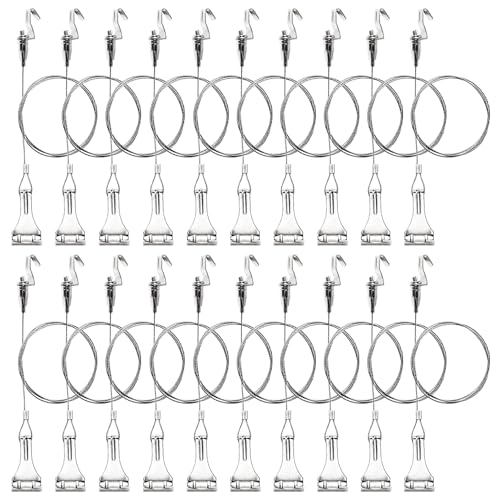
Package Included: Okllen set of 20 picture rail hanging kit comes complete with 20 rail molding hooks, 3ft / 39" loop cord, and 20 adjustable hooks. This kit is designed for a seamless and hassle-free picture display experience.
Go Vertical With Tension Rods: Zero Wall Contact
You’ve exhausted your horizontal surfaces, yet hesitate to mar unblemished plaster—enter the tension rod, that unassuming cylinder of compression-hung steel poised between floor and ceiling like a drawn breath. Tension rods unlock wall-safe hanging that respects your vertical boundaries entirely.
You’ll compress these slender sentinels between architectural planes—window frames, alcoves, or room corners—creating instant infrastructure for a no-nail display. Suspend wires or slender cords from the rod’s length; gravity becomes your curator, distributing weight evenly while your walls remain pristine.
This rental-friendly solution permits spontaneous reconfiguration. Build multi-level galleries that ascend without drills, anchors, or regret. When dimensions shift or tastes evolve, you simply release tension and vanish.
For compact quarters demanding flexibility, tension rods offer sculptural possibility: adjustable, reversible, utterly indifferent to permanence.
Recommended Products

Package includes: 50 Pieces small black hangers, 100 Pieces 10 mm screws. Suitable for small frames.

Z Bar Cleats Hangers are made of extruded aluminum 1-1/4" wide by 3/32" thick.

Package Includes: 30 x Molding Hooks. Total Size: 55 x 34mm/2.2" x 1.3"(H*W)
Skip Wall Mounting: Use Mantels and Shelves Instead
Tension rods suspend your collection in midair, yet some compositions crave earthbound stability—the weight of oak, marble, or fired brick beneath them. You anchor a single commanding canvas on your mantel display, recessing it from the rim’s precipice so gravity cooperates, not colludes against you. Monitor the ambient breath around it: fifty-five percent relative humidity preserves pigment and paper alike.
You expand this terrestrial grammar by flanking the hearth with a shelf display, orchestrating asymmetrical shadows and negative space between ledges. Layer diminutive framed works against volumes, allowing objects to converse across horizontal planes. You’re avoiding wall nails entirely, yet constructing deliberate sightlines that read as curated, not provisional. Seasonal rotations demand mere displacement—no spackle, no touch-ups, no surrender of security deposits.
Recommended Products

INCLUDES- 3 metallic gray hangers, 6 large strips, 6 stabilizer pairs; 1 hanger holds 5 lbs

Versatile and Comprehensive Package: our package comes with a diverse range of 45 picture hangers for frames, it includes 15 round hangers with a diameter of about 0.87 inches, 15 small square hangers of about 0.98 inches, and 15 large square hangers of about 1.26 inches, never worry about finding the right size hanger again with our comprehensive pack

Match Weight to Method: Choose Your No-Nail Solution
How precisely does your piece negotiate with gravity? You’ll need to calibrate your approach with exactitude. Adhesive strips suit lightweight compositions admirably—Command™ variants accommodate sixteen pounds per pack—but you’ll scrutinize that weight rating meticulously before committing. Heavier works demand strategic distribution: multiply your hooks or strips to disperse gravitational load across broader surface areas.
Prior to application, you’ll cleanse the wall with isopropyl alcohol, pressing firmly before allowing one hour’s curing time. This no-nail solution preserves pristine surfaces, particularly advantageous for transient arrangements or rental dwellings.
Should your piece exceed adhesive capacities, you’ll pivot toward tension rod systems or picture rails—elegant alternatives that suspend substantial works without penetrating plaster. Spatial harmony requires matching mass to mechanism with unwavering precision.
Recommended Products
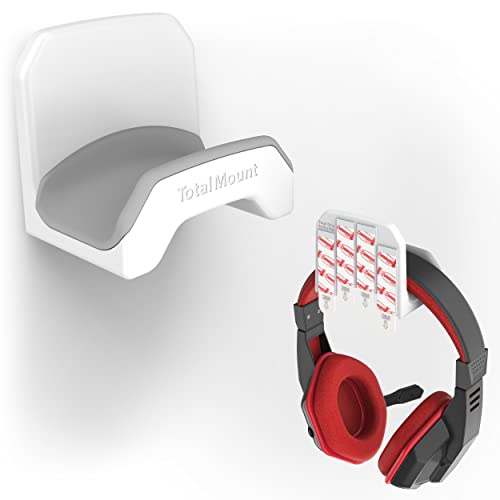
TotalMount headphone hangers enable you to mount your headphones almost anywhere including on a wall, desk, or PC case.

【Invisible & Sleek Design】 Crystal-clear hooks blend seamlessly with any wall, leaving your home looking neat and stylish without bulky hardware.
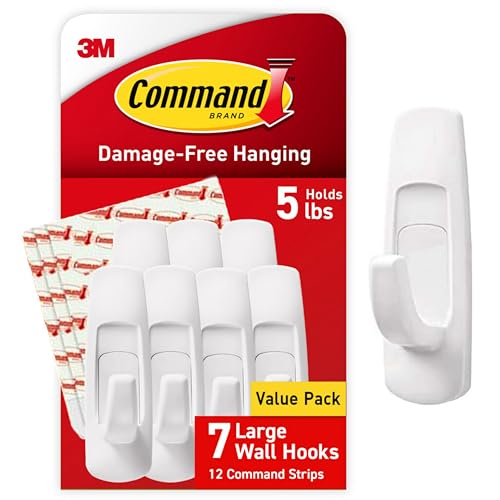
HOLDS UP TO 5 POUNDS: One package of the Command Large Utility Hooks includes seven wall hooks and 12 adhesive strips; each utility wall hanger can hold up to 5 pounds
Conclusion
You needn’t resign your walls to bareness nor surrender them to perforation. From discreet adhesive strips caressing smooth surfaces to commanding rails tracing horizontal planes, your spatial tableau awaits curation. Assess each piece’s gravitas, survey your architectural envelope, and orchestrate an installation that honors both aesthetic vision and structural integrity—transforming passive enclosure into deliberate gallery without a single breach.