
You stand before a lamp, its naked bulb glaring, and realize the shade transforms more than light—it orchestrates atmosphere, proportion, and shadow. Yet the calculus of circumference, drop, and hardware integration eludes most. The wrong proportion divorces base from crown; the incorrect fitting threatens tilted asymmetry. Your selection demands precise measurement and visual discernment, for the shade does not merely adorn.
Measure Your Lamp Base for the Right Lampshade Size
How does one achieve equipoise between luminaire and luminescence? You’ll commence with meticulous measurement of your lamp base, employing its height as the foundational datum for dimensional harmony. Establish proportion by selecting shade width approximately twice your base’s breadth—though table lamps tolerate equivalence—while deriving shade height from systematic calculation against total lamp height, encompassing bulb and harp within your assessment. You’ll verify the shade obscures hardware entirely, resting precisely above the lamp’s architecture, with the harp concealed beneath the silhouette’s perimeter. This measurement protocol ensures your shade height—typically one-third to two-thirds of the composite dimension—preserves visual equilibrium.
Neglect these ratios, and you’ll court top-heaviness or structural disharmony. Precision yields luminosity without compromising spatial poetry.
Pick the Best Lampshade Height for Balance
Where precisely should your shade terminate to achieve visual equipoise? You’ll establish optimal shade height proportion by calibrating your lampshade height to approximately two-thirds of your base height, though one-third of total lamp height also yields satisfactory results. For any table lamp, position the shade to obscure the harp from standard viewing angles while maintaining deliberate balance between illuminated aperture and sculptural foundation.
Gauge your proportional relationship: taller, slender bases demand extended vertical shades, whereas compressed, voluminous foundations require abbreviated, expansive treatments. You’ll verify that the shade’s lower rim clears the base apex sufficiently to conceal socket mechanics, ensuring your shade height sustains compositional unity without dominating or diminishing the base’s visual mass. This calibrated shade height proportion creates architectural coherence, transforming functional illumination into refined aesthetic statement.
Recommended Products

Make Sure Your Desired Size: Top: 16 inches, bottom: 16 inches, height: 9 inches, screw thread: 1.65 inches,drum lamp shade is suitable for E26 & E27. Please check the ring diameter of the light frame carefully before purchasing.
Calculate the Right Lampshade Width
You measure round bases straight across; for square bases, you measure diagonally to capture true span. The shade must rest slightly above the lamp’s apex, concealing hardware while precluding visual top-heaviness. When uncertain, you’ll select a width that fills the spatial envelope and resonates with room scale, anchoring surrounding furnishings in cohesive equilibrium. Consequently, dimensional exactitude yields luminaria of refined, architectural integrity.
Match the Lampshade Shape to Your Lamp Base
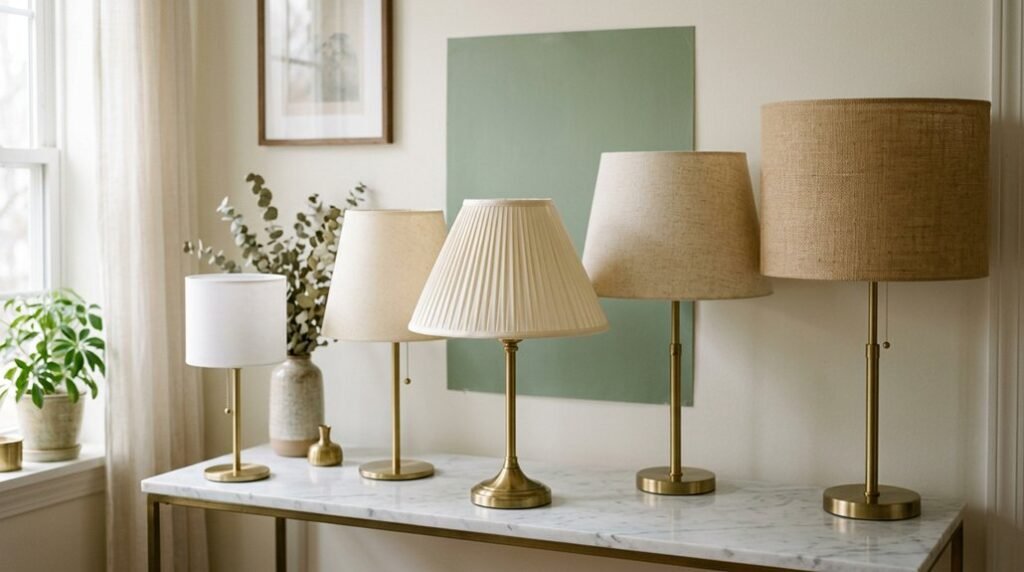
The geometry of your lamp base demands a shade that completes its visual statement rather than competes with it. You’ll achieve cohesive elegance by mirroring your shade shape to your base silhouette. Round bases harmonize effortlessly with drum shade or empire shade forms, creating visual continuity through curved geometries. Square bases require angular reciprocity—pair them with rectilinear shades that echo their orthogonal precision.
Your empire shade functions as a versatile foundational element, particularly within classical interiors, while a tapered drum shade accommodates contemporary sensibilities. Candlestick lamp bases offer greater latitude, tolerating diverse shade shape selections without compromising compositional integrity.
Though alignment proves reliable, you may deliberately contrast forms for deliberate tension. Exceptions remain valid when your spatial arrangement demands focal disruption rather than seamless integration. Ultimately, you’re calibrating proportion and silhouette to achieve luminous equilibrium.
Scale Your Shade to the Room Size
Once you’ve harmonized shape with silhouette, turn your attention to dimensional presence. Your lamp shade size must converse fluently with room scale; expansive interiors welcome generous floor lamp shade proportions to cast light across broader planes, while intimate quarters demand restraint—a compact table lamp shade prevents spatial suffocation.
You’ll achieve equilibrium by calibrating shade width against base width: target approximately double the base width for poised suspension above surrounding furnishings. For table applications, elevate shade height to two-thirds or three-quarters of the base height, ensuring a proportional shade that doesn’t destabilize visual harmony.
In constricted corridors or congested side arrangements, you’ll eliminate “flying elbows” by selecting shades with disciplined lateral extension. Should uncertainty arise, gravitate larger—amplified dimensions typically orchestrate superior luminous diffusion and compositional balance within the architectural envelope.
Choose Materials That Create the Right Light
How does a silk veil transform a harsh bulb into a lantern’s soft embrace? You achieve this through deliberate material selection. Silk offers exquisite translucence, bathing your space in warm, diffused radiance ideal for ambient illumination. When you require focused beams, you’ll select opaque fabrics like thick parchment that block lateral spill and direct illumination downward.
Consider your inner surface carefully: white or off-white linings amplify brightness and reflection, enhancing task-oriented functionality. For mood lighting, you’ll embrace darker, denser textiles that sculpt dramatic contrast and intimate atmosphere. Cotton delivers durability with cleanability; linen imparts organic texture. You must weigh environment too—woven, parchment-like constructions withstand humidity outdoors, while delicate fabrics demand sheltered interiors. Your fabric choice ultimately orchestrates how light behaves within your space.
Choose Lampshade Colors and Patterns That Work
Where might your boldest aesthetic statement reside? Consider your lampshade colors and patterns as the definitive answer. In interior design, contrast governs visual hierarchy—traditional ikat patterns against solid bases generate precisely this dynamic tension, while geometric motifs confer modern precision. Floral patterns evoke timeless comfort within classic settings, though you’ll balance them carefully against the base’s visual weight.
Your color strategy demands contextual awareness. Deploy bold lampshade colors as deliberate focal points amid neutral schemes; conversely, white/off-white interiors compel you to introduce accent hues through colored shades. You needn’t mirror curtains or carpets exactly—experimentation with contrast yields an unexpectedly cohesive look.
Clip-on varieties facilitate this exploration, enabling rapid testing without permanent commitment. You’re curating atmosphere through chromatic and patterned intentionality.
Recommended Products

Make Sure Your Desired Size: Top: 17.5 inches, bottom: 17.5 inches, height: 10 inches, screw thread: 1.65 inches, beige large drum lamp shades is suitable for E26 & E27. Please check the ring diameter of the light frame carefully before purchasing
Pick Your Texture: Smooth, Pleated, or Embellished
Why settle for a single visual note when texture conducts the room’s entire atmospheric symphony? Your selection of lamp shade texture determines how light behaves and resonates within your space.
Smooth shades—think silk or plain linen—deliver clean, contemporary lines with even light diffusion, adapting seamlessly to modern interiors. You’ll find them effortlessly versatile. Pleated shades introduce time-honored warmth, softening both acoustics and atmosphere through their rhythmic folds. When you seek drama, embellished shades with embroidery or painted details command attention; you’ll balance these with simpler bases to avoid visual chaos.
Consider translucency: sheer materials yield ambient light, while opaque constructions sculpt defined beams for targeted mood lighting. Master texture pairing by juxtaposing surfaces—a smooth shade against an ornate base, or pleated elegance beside minimal metal—to achieve compositional harmony without competition.
Verify Your Lampshade Fitting Type
Texture sets the mood, yet even the most exquisite shade falters without proper integration into your luminaire’s architecture. Before purchasing, verify your lampshade fitting type to ensure seamless cohesion with your fixture.
Duplex shade carriers require you to loop the smaller ring over the neck, securing with the cap for stability. Fixed fitting configurations demand attention to shade compatibility with your bulb holder specifications—E14 or E27—potentially necessitating a converter ring to eliminate interference. Always install during daylight hours, examining shade alignment meticulously before illuminating. Recheck that the shade conceals the harp or fitter properly, ensuring no obstruction of the bulb or switch mechanism. Precision in these technical details preserves both aesthetic integrity and functional safety.
Mix and Match Shades and Bases
How might you discover the pairing that transforms your luminaire from mere illumination to sculptural statement? You’ll leverage the mix-and-match feature to survey myriad shade-base combinations, filtering by size, material, and design to isolate options that honor your lamp’s dimensions and spatial context.
Test multiple configurations before committing. You’ll juxtapose shade and base shapes—round upon round, square against square—to achieve visual coherence through deliberate proportion. Place several shade contenders atop your base to assess light diffusion and spatial presence; observe how each alters the silhouette’s volumetric dialogue with its surroundings.
When uncertainty persists, you’ll deploy Empire shades as your failsafe. Their tapered geometry and balanced proportion complement virtually any base style, ensuring sophisticated resolution across diverse interiors without compromising technical harmony.
Conclusion
You’ve navigated proportion, geometry, and materiality with deliberate precision. Your selected shade now harmonizes lumens with line, concealing mechanism while broadcasting ambient glow. Trust your measured eye: the silhouette complementing the base, the diffusion modulating atmosphere, the fitting securing seamlessly. This calculated curation culminates in an object that transcends mere utility, becoming an articulate element within your spatial composition. Illuminate accordingly.