

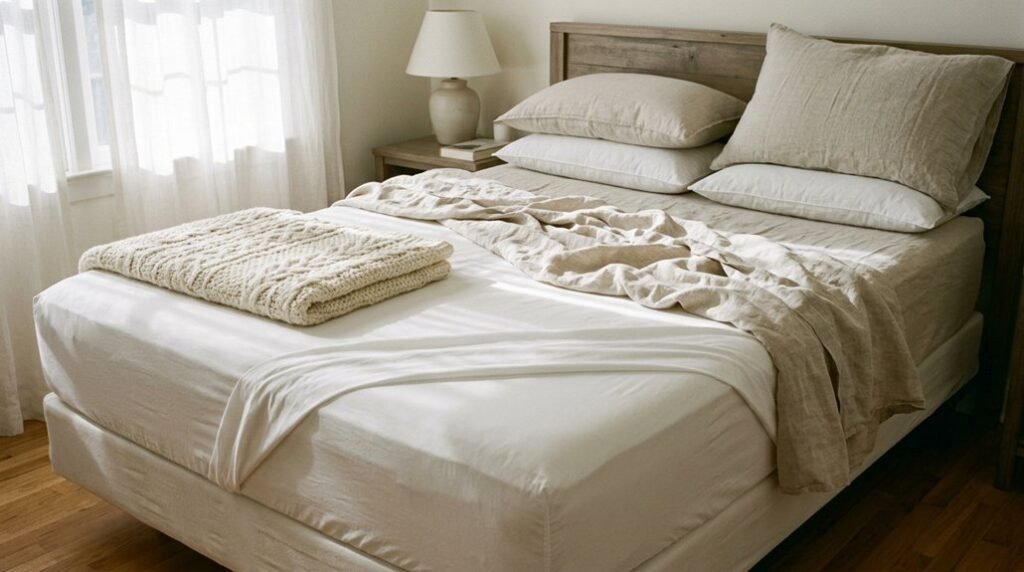
You’ve mastered the fitted sheet, tugged it tight over deep corners, but you’re still waking to a bed that looks unfinished. The difference between a slept-in mess and that hotel-suite silhouette isn’t more pillows—it’s sequence, weight, and deliberate restraint. Start with cotton that breathes, then ask yourself what you’re hiding versus showcasing. There’s a method to the folds, and one wrong layer collapses the whole composition. You’re closer than you think.
Choose a Fitted Sheet by Depth, Fabric, and Color
The foundation of any well-dressed bed begins where you least see it. You’ll anchor your entire bedding scheme with a fitted sheet selected precisely for your mattress depth—measure carefully, as dimensions vary significantly across brands. Seek cotton fabric with a refined handfeel; long-staple varieties offer superior breathability and that coveted lived-in softness after washing. Deep pockets prove essential, particularly for pillow-tops or hybrids, ensuring tension holds taut through the night without riding up corners.
Curate your color palette from the ground up: ivory, soft cream, or warm white establish a versatile substrate that accommodates seasonal shifts in duvets and coverlets. You’re building a system where every element serves both function and visual coherence.
Recommended Products

Fitted Sheet - Queen size Fitted Sheet by Utopia Bedding measuring 60 by 80 inches with a 15 inches deep pocket that fits over-sized mattresses up to 15 inches deep and designing that complements your bed set quite well

1 KING FITTED SHEET - SOLD INDIVIDUALLY (NOT A SET): Backed by the Good Housekeeping Seal, these 400 thread count balanced weight 100% long-staple cotton sateen king fitted sheets have a silky-smooth feel that gets softer with every wash. Durable and suitable for all season comfort. Refresh your bedding essentials with this king size fitted sheet.
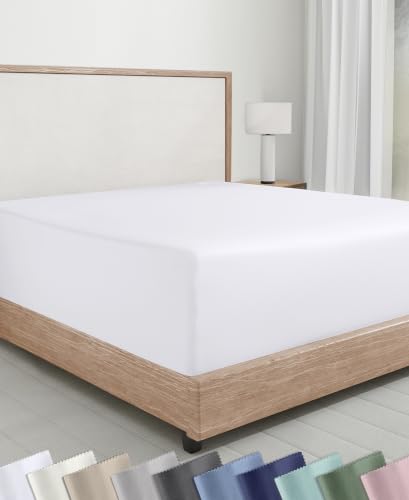
1 QUEEN FITTED SHEET Only (NOT A SET): Backed by the Good Housekeeping Seal, this 100% cotton deep pocket queen fitted sheet (60"W x 80"L) is soft and durable. This cotton fitted sheet starts with a slightly crisp feel and gets softer with regular washing.
Layer a Crisp Top Sheet to Hide Wrinkles and Fur
Your fitted sheet now anchors the bed; next, you’ll cast a crisp top sheet over it to mask the inevitable—wrinkles pooling at the foot, fur drifting from passing pets, the small chaos of daily use. This top sheet layer serves as your first visual defense, creating a smooth plane where the fitted sheet’s texture disappears beneath clean cotton or linen.
When layering, pull the top sheet taut and evenly across the mattress, ensuring it extends symmetrically on all sides to maintain a balanced silhouette. You’ll fold the top edge down strategically, revealing intentionality in your approach and signaling the curated depth beneath. Proper placement eliminates bulk and unifies your bed’s aesthetic. The top sheet’s crisp surface now conceals what lies below—wrinkles, fur, the lived-in reality—while presenting only controlled, technical elegance.
Recommended Products

SOFT AND COZY: Experience ultra-soft comfort with our 120 GSM brushed microfiber sheet set
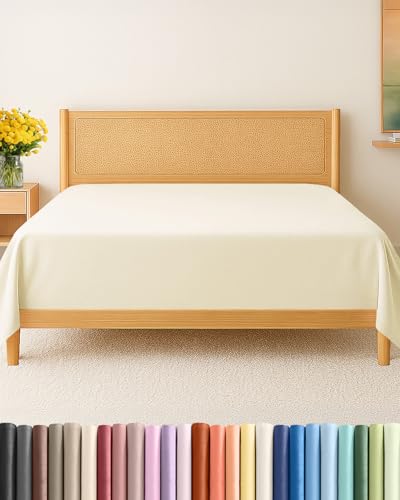
KING SIZE FLAT SHEET ONLY: This King flat sheet is perfect for layering or solo use. Made without elastic, it lays smoothly over your bed and helps protect your comforter or duvet. Soft, breathable, and ideal for homes, guest rooms, hotels, or dorms.

SNUG FIT THAT STAYS ON ALL NIGHT – Designed with deep pockets and 360° all-around elastic, this King fitted sheet hugs mattresses up to 16” thick—even with toppers or pads. No more slipping corners or bunching up while you sleep.
Hide a Lightweight Duvet Under the Mattress for Warmth
Why sacrifice warmth for visual restraint when you can bury a lightweight duvet beneath the mattress instead? Slide a bottom duvet under your fitted sheet, tucking the edges deep beneath the mattress where they’ll vanish completely. This bed layering technique delivers warmth hidden under mattress lines without disturbing your curated silhouette.
Select a lightweight duvet in a down alternative fill—you’ll trap body heat without adding visible bulk. Match the insert precisely to your cover dimensions; anything oversized bunches, anything skimpy shifts. You now control temperature discreetly.
The duvet under the mattress remains your invisible asset: functional, undetectable, architecturally clean. Your surface stays uncluttered. Your sleep stays insulated. The bottom duvet does the thermal work so the top layers handle only aesthetics.
Recommended Products

SOFT AND COZY: Experience ultra-soft comfort with our 85 GSM brushed microfiber sheet set

ULTIMATE COMFORT: Get ready to sleep soundly every night with your new luxurious twin bed sheets. Soft, cozy and comfortable, they're the perfect way to treat yourself to the ultimate sleep experience.

SLEEPS COOL, RESTS EASY - Independently tested by three accredited labs (Intertek, Hohenstein, and IDFL), rated in the top breathability tier. This buttery-soft microfiber lets heat and moisture pass through instead of trapping them against your skin, so you fall asleep faster and stay asleep longer.
Fluff a Heavyweight Top Duvet for Fullness
How do you achieve that cloud-like volume without structural collapse? You select a heavyweight duvet as your outer layer and pair it with a lighter bottom layer—this layering strategy prevents excessive bulk while preserving proportion.
You match your insert carefully: size it precisely to the duvet cover for balanced fullness, or choose a down or down-alternative insert two inches larger for extra fluff.
You avoid edge-bulking by ensuring proper insert-to-cover ratios.
You fold the top duvet at the headboard or tuck it around the mattress, sculpting visible volume into a clean, polished silhouette.
You fluff the insert evenly throughout the cover, redistributing fill to eliminate flat spots.
Your heavyweight layer becomes both thermal anchor and aesthetic centerpiece—structured loft that reads intentional, never sloppy.
Recommended Products

ALL-SEASON COMFORT: Featured in Good Housekeeping's 2025 comforter coverage and Editor-Tested by Real Simple, this down alternative comforter undergoes 32+ steps for a softer touch. GentleSoft polyester fill and a durable shell provide cozy warmth in winter and breathable comfort in summer, making it an ideal Gift for Her
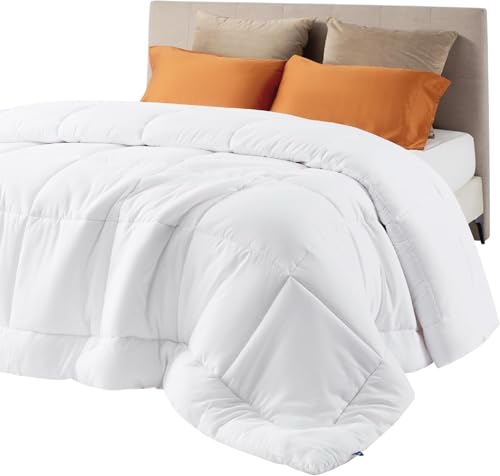
ALL-SEASON COMFORT: Featured in Good Housekeeping's 2025 comforter coverage and Editor-Tested by Real Simple, this down alternative comforter undergoes 32+ steps for a softer touch. GentleSoft polyester fill and a durable shell provide cozy warmth in winter and breathable comfort in summer, making it an ideal Gift for Her

Twin comforter or duvet insert with soft down-alternative filling; convenient all-season light weight
Drape a Textured Quilt or Coverlet for Depth
Once the duvet achieves its architectural loft, you’re ready to introduce the dimensional layer that separates functional bedding from intentional design.
You’ll select a textured quilt or coverlet—perhaps a kantha stitch piece, a matelassé weave, or a channel-stitched cotton layer—to create depth through deliberate layering. Position the textured quilt so it covers both mattress sides evenly, then drape it with calculated asymmetry or gather it center-bed for amplified volume. You’re building a topography of textiles where each plane catches light differently.
Alternatively, you’re deploying an oversized blanket or lightweight comforter as your coverlet substitute—linen for slubbed imperfection, velvet for luminous pile, woven wool for graphic structure. The coverlet bridges the duvet’s bulk and the bedscape’s subsequent refinement. You’re establishing visual hierarchy through contrasting weights, ensuring the layering reads intentional rather than accumulated.
Prop Euro Shams Against Sleeping Pillows
Where does the eye travel after the coverlet settles? Upward, toward the vertical plane where bed layering achieves its architectural finish. You’ll prop euro shams against sleeping pillows to establish this back-row structure, creating that curated, hotel-style silhouette you’re pursuing.
For proportionate pillow sizing, you’ll scale to your frame: two euro shams for a King bed, three for a Queen. You’ll select textured solids or patterns that complement, not compete. You’ll stuff each cover with sham inserts two inches larger than their shell—down or down-alternative—to achieve ideal fullness. This technical precision ensures your pillows stand tall, never slouch.
You have now locked the back layer into place. The arrangement commands attention without chaos, and your bed reads as intentional, elevated, complete.
Recommended Products

Cashmere Soft & Silky King Fitted Sheet Only: Pure luxury and unrivalled softness from Lonestar Lovin' by Texas Linen Co. Made with finer Egyptian cotton fibers, these king fitted sheet cotton are the most durable fitted bed sheets you'll ever sleep on — rejuvenating sleep, every night.

TOMMY HILFIGER HOME: Classic American preppy brand known for its bold use of red, white, and blue, offering high-quality apparel, accessories, footwear, and bedding, with a global presence and strong cultural ties to streetwear, hip-hop, and fashion collaborations.
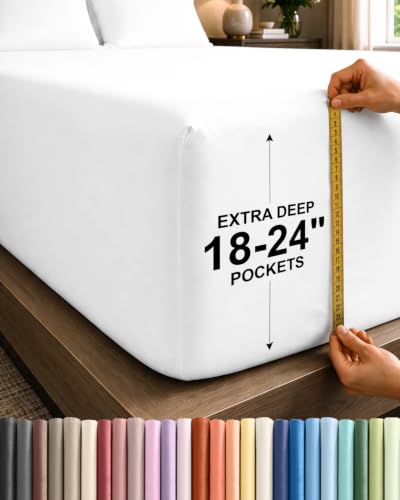
OTHER WHITE QUEEN SHEETS OFTEN PULL LOOSE FROM THE MATTRESS while you’re sleeping and are a struggle to get on your bed, even when you buy the right size. At CGK Unlimited, we’ve designed our white queen bed sheets with extra deep pockets to easily fit mattresses 18”–24” deep, so it’s a cinch to put on the bed – even with a mattress topper! our deep fitted white sheets queen also feature elastic all the way around its edges to hug your mattress securely – no more balled up sheets!
Size Sleeping Pillows to Your Bed
Your vertical arrangement now demands horizontal balance. Select sleeping pillows scaled precisely to your bed size—king dimensions require king sleeping pillows with corresponding pillowcases, while queen configurations accept standard or queen sizes. This pillow sizing ensures proportional harmony across your mattress plane.
Position these sleeping pillows as your foundational layer, anchoring the composition before additional elements accumulate. You’ll establish visual equilibrium when pillow dimensions correspond directly to bed size, preventing dwarfed or overwhelming silhouettes.
Choose pillowcase/color in restrained neutrals—ivory, stone, or warm white—to maintain chromatic continuity throughout your layered bedding scheme. These muted tones recede intentionally, allowing subsequent layers to advance visually without competing for attention.
Your sleeping pillows thus perform dual function: ergonomic support and compositional grounding, their scaled presence establishing the measured rhythm upon which your complete bedding architecture rests.
Recommended Products

ULTRA SOFT COMFORT: Crafted from premium 100 GSM fabric and finished with our signature brushing process for exceptional softness, breathability, and durability.

600 TC Flat Sheet Only: Need a Flat/ Top Sheet Only? This Is For You: Includes one cotton twin flat bed sheets only, 66” W x 100” L — not a set ( fitted sheet & pillowcases NOT INCLUDED). This Cream (Warm Ivory) shade is a soft, warm ivory with a hint of beige–it is not a soft white or a cool beige. Use it over your fitted sheet or as a breathable layer under a blanket, quilt, or comforter. Finished with a 4” double-needle hem for added strength and a polished look.

WHAT’S INCLUDED: 3 Piece Twin Sheet Set Includes: 1 Twin Fitted Sheet: 39" x 75" x 15", 1 Twin Flat Sheet: 66" x 96", 1 Standard Pillowcase: 20" x 30". The fully elasticized fitted sheet snuggly fits mattresses 6 to 15 inches deep.
Pop a Lumbar Pillow in Front for Color
Why stop at foundation when a single horizontal element can reframe your entire composition? You anchor your bed styling with a lumbar pillow positioned precisely in front of your sleeping pillows, creating deliberate layering that builds visual depth across the horizontal plane.
Select a lumbar pillow measuring 14–16 inches tall and 24–40 inches long—proportions that maintain technical balance without dominating your arrangement. You’ll introduce a controlled color accent through this piece, choosing a solid hue or subtle pattern that activates against your neutral palette. This approach keeps your base layers interchangeable and seasonally flexible. Opt for textured fabrics or modest dimensions to preserve hierarchy among elements. The lumbar pillow functions as your curated punctuation mark: removable, precise, and intentionally placed to complete the dimensional story of your bed.
Recommended Products

PREMIUM FABRIC: Royale Linens Flat Bed Sheet Is Manufactured Using Finest Quality 100% Double Brushed Microfiber. Making Them Breathable, Comfortable And Cozy. WASH BEFORE THE FIRST USE TO UNLOCK SOFTNESS
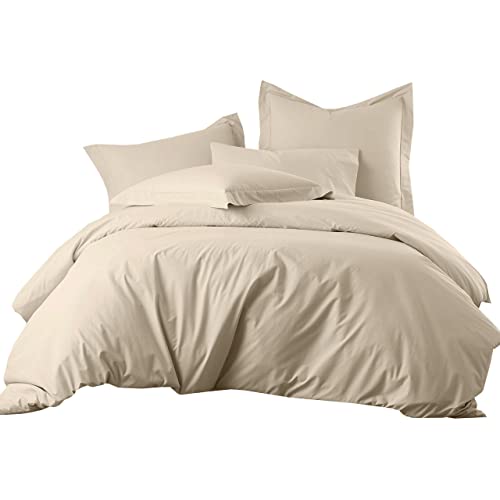
{Material} Luxury Hybrid Cotton and Polyester Duvet Cover, Smooth and Elegent Duvet Cover set with Button Closure, 650 Thread count 70 % cotton 30 % Polyester

PREMIUM FABRIC: Royale Linens Flat Bed Sheet Is Manufactured Using Finest Quality 100% Double Brushed Microfiber. Making Them Breathable, Comfortable And Cozy. WASH BEFORE THE FIRST USE TO UNLOCK SOFTNESS
Toss a Throw Blanket on for Easy Texture
How else do you signal completion without adding that final, tactile dimension? You drape a throw blanket at the bottom corner, instantly injecting texture into your layered bed. This accent piece complements your duvet/cover, creating visual tension between structured bedding and relaxed folds.
You control the drape—ripple it casually or fold it with precision. Either approach elevates bed styling without overwhelming the composition. Match your throw’s width to the duvet/cover; anything narrower reads truncated, anything excessive competes.
The beauty lies in versatility. You swap textures seasonally—chunky knits for winter, lightweight weaves for warmer months—refreshing the entire layered bed without dismantling your foundation. It’s the simplest upgrade with maximum impact, proving that intentional texture transforms function into curation.
Recommended Products

*All-season comforter duvet insert* Ultra-soft microfiber polyester fabric covering for more fluffiness. No Noise, More Breathable, and less likely to Tear or have Horrible Odors.
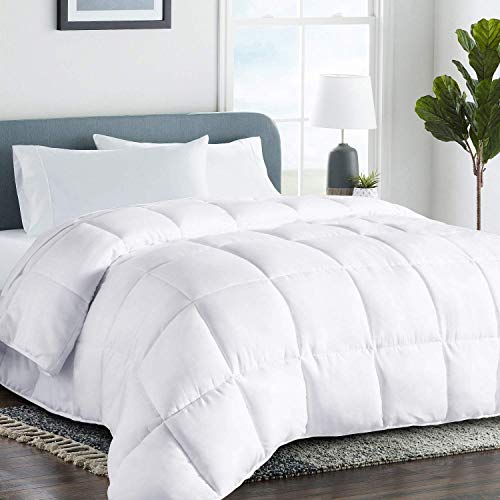
1.Premium whole-piece filling: extremely SOFT and NOISELESS brushed fabric cover, our comforter is the perfect choice for all people at different ages.

1.Premium Material Collection: Covered by high quality textile showcases a delicate yet pristine appeal to you. The fabric is Ultra SOFT and BREATHABLE, suitable for year round use. We ensure you a long-lasting wholesome sleeping ambience to be surrounded by all natural comfort.
Conclusion
Layer your bed like you curate a collection—every element deliberate, every texture considered. You’ll balance depth with restraint, warmth with breathability, seasonality with permanence. Trust your eye: fitted precision, draped softness, propped structure. Refresh seasonally, edit ruthlessly, and let the foundation hold. Your bed becomes silhouette and sanctuary—technical, tactile, entirely yours.
Recommended Products
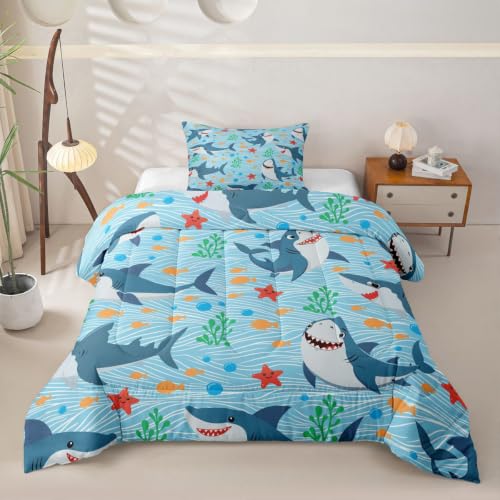
What You Can Get: 1 x Twin Comforter 68"x 90", 1 x Pillow Case 30"x 20"

What You Can Get: 1 x Full Comforter 79"x 90", 2 x Pillow Cases 30"x 20"

Secure Duvet Insert System: No more duvet droop, it keeps your duvet comforter inserts securely and evenly positioned in the duvet cover, preventing sliding down from gravity and daily use. Plastic clips may be laundered, eliminating need to remove and replace for washing. Plastic clips are strong and secure, yet gentle on material