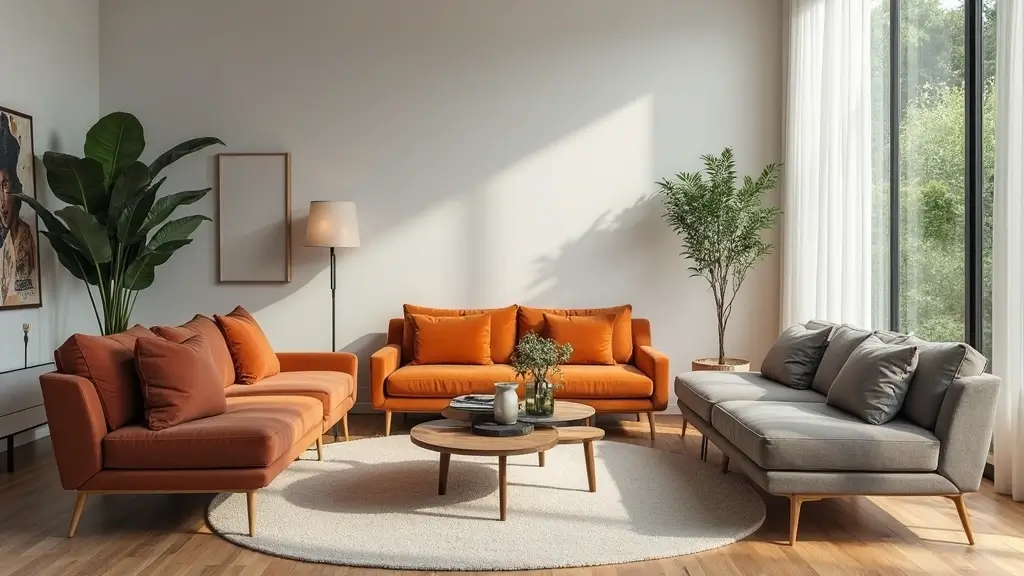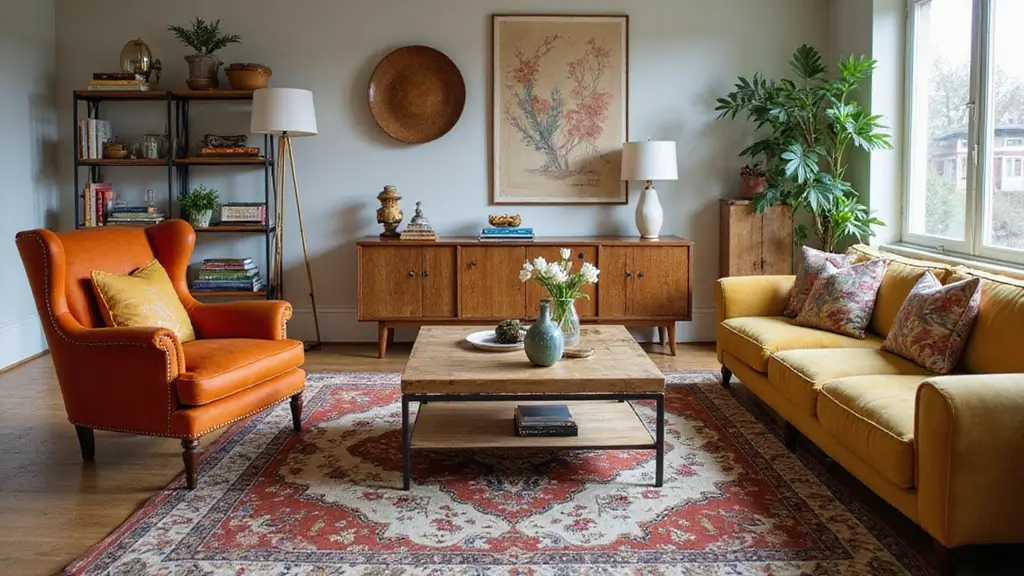

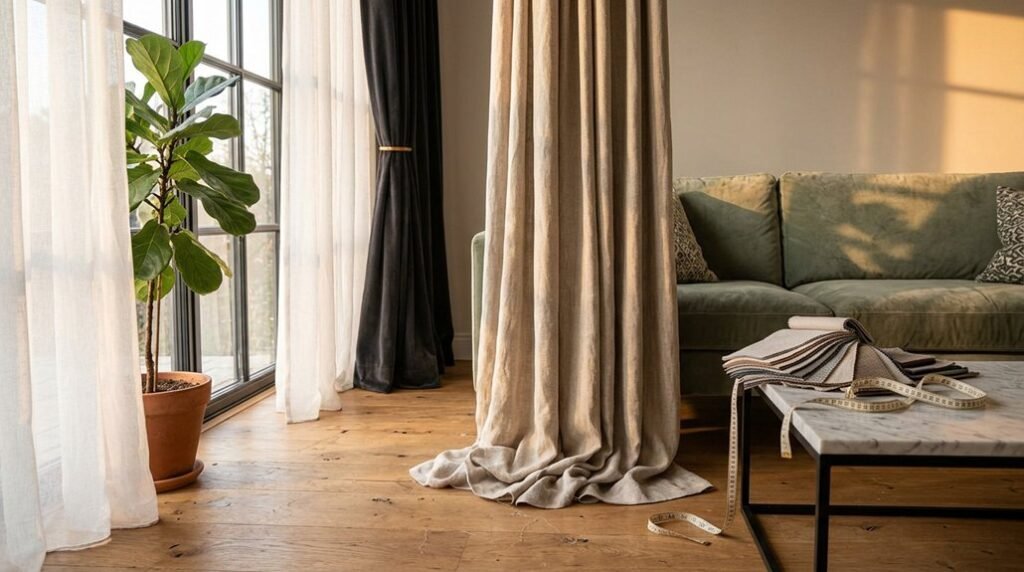
You stand in your living room, tape measure in hand, and realize curtains do far more than block light—they frame your windows, soften hard edges, and pull the whole space together. But with endless fabrics, lengths, and hardware options, you’re likely wondering where to actually begin. The wrong choice can shrink your windows or clash with your sofa, while the right one transforms the room entirely. Here’s how to get it right.
Measure Your Living Room Windows Correctly
Where do you begin when dressing your living room windows? You start with precise window measurements. Grab your tape measure and record the width and height of each opening. For width, you’ll apply a fullness factor of 2 to 3 times the window width—so a 60-inch window needs two 52-inch or 54-inch panels for that lush, gathered effect.
Next, tackle rod placement: mount your rod 4 to 6 inches above the frame and extend it 3 to 6 inches beyond each side. This positioning lets curtains fully clear the glass.
Finally, determine curtain length by measuring from the rod hang point to the floor, then subtract ½ to 1 inch. Your panels will skim the floor cleanly, avoiding puddles while maintaining tailored proportions.
Recommended Products

Fabric and Workmanship: Quality fabric feels soft, heavy and comfortable. The material is polyester. Exquisite workmanship, seaming, thread trimmed.
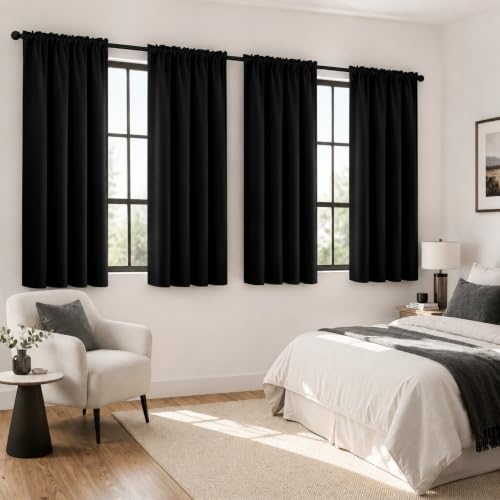
Package Includes & Material: Each package includes 4 black blackout curtains, each measuring 54 inches in length and 40 inches in width, with a total width of 160 inches for the 4 curtains. The 4-piece set provides fuller pleats and wider coverage, which is usually more cost-effective than purchasing two separate 2-piece sets. These curtains are the same colour on both sides. Made from thick 225 GSM matte single-layer fabric, these curtains drape neatly, creating a clean, modern look

SET DETAILS: 2 panels per package. Each panel measures 38 inch wide by 54 inch long with 6 silver metal grommets (1.6 inch inner diameter) on top, easy to install and slide.
Choose the Right Fabric Weight for Light and Privacy
Once you’ve nailed down your measurements, you’ll turn your attention to fabric weight—perhaps the single most important decision for how your living room feels throughout the day. You’ll balance light control and privacy by selecting materials that match your lifestyle. Linen offers breathability and temperature regulation, working beautifully as sheer panels for soft daylight or layered blackout designs for complete seclusion. You’ll find velvet creates dramatic darkness but sacrifices brightness, while silk provides adjustable filtration across thicknesses. Budget-friendly silk-like polyester delivers airy elegance with simpler upkeep.
You’ll maximize flexibility by layering sheer under blackout curtains, achieving privacy without sacrificing texture. Your fabric weight choice directly shapes whether your space feels open and sunlit or cocooned and intimate.
Recommended Products

WELL MADE: Sold as 2 panels, each panel is W52" x L84", and W104" x L84" in total. Each curtain panel has 2-in-1 top style design: rod pocket and back tab. With 3-inch inner diameter fit most standard rod. Curtains also can be hung with clip rings. 3 ways meet your various needs.

READY MADE: 2 Linen Curtain Panels per package.Each panel measures 52 inches wide by 96 inches long. Top design of Back tab & loop pocket provide 3 hanging options. <1> hanging from the back patch to create an elegant pleated look, <2> from the 3 inch rod pocket for a classic look <3> Hanging with clip rings for easy, slide open and closed (clip rings are not included)

WELL MADE: Sold per pair(set), including 2 linen sheer panels - Panel measures: 52 x 108 - inches|Set measures: 104 x 108 - inches. Each panel has 8 nickel grommets, constructed with head height: 4", bottom hem: 2", fitting up to 1 1/4 inches curtain rods/poles
Pick Colors That Work With Your Living Room Palette
How do you pull a room together without repainting the walls? You use curtains color harmony to anchor your living room palette.
Start by coordinating with furniture—match your curtains to dominant wood tones and upholstery so everything flows. If your walls are neutral, you’ve got freedom: choose bold vs neutral shades by going vivid for a focal point, but avoid hues too close to your walls or you’ll look washed out.
Try layering curtains to balance function and style—let sheers blend with wall tones while blackout panels add depth. Follow the color rule 60-30-10: your curtains can reinforce that 60% base color, keeping accents in smaller pieces. If you pick bold or printed panels, ensure they complement existing patterns rather than compete.
Recommended Products

WELL MADE: Sold as 2 panels, each panel is W52" x L96", and W104" x L96" in total. Can be hung separately, or hung together with sheer curtains in MIULEE.

WELL MADE: Sold as 2 panels, each measuring 52"W x 84"L (from top edge of installed rod to bottom). Curtains with GROMMET TOP are easy to slide.
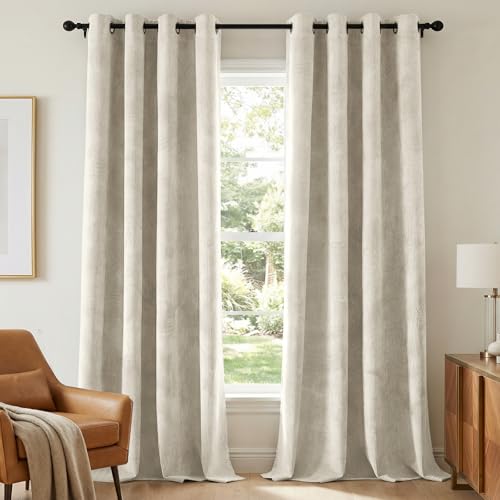
PAIR SOLD: 2 panels in package. Each panel measures 55"W x 108"L| Pair measures 110"W x 108"L. Thread trimmed and wrinkle free, panel is constructed with 8 anti rust grommets which fit well up to 1 1/2 inches curtain rods
Decide Between Solid, Patterned, or Textured Living Room Curtains
You’ve locked in your color palette—now you’re deciding what actually hangs at your windows.
Start with solid curtains if you’ve got bold wallpaper or patterned furniture; they create a cohesive backdrop that lets statement pieces shine.
Choose patterned curtains when you want window treatments to command attention—just remember large patterns suit spacious rooms while small ones fit tighter spaces.
Opt for textured curtains like linen weave or velvet when you crave depth without adding competing visuals; the tactile richness enhances atmosphere quietly.
You can also layer curtains cleverly—pairing solids with sheers preserves privacy light while softening brightness.
Whatever you select, coordinate with walls and furnishings to maintain your design language. Your window treatments should feel intentional, not accidental.
Recommended Products

Basic Information:The grommet top has an inner diameter of 1.6 inches. Each curtain panel is available in 35-inch and 52-inch width options. Available lengths: 63 inches, 72 inches, 80 inches, 84 inches, 90 inches, 95 inches, 102 inches, 108 inches, and 120 inches. Each set includes 2 detachable tiebacks.

Talia Double Layer Sheer and Room Darkening Blackout Indoor Curtains 2-Pack

Ready Made:Package includes 2 panels of double layered blackout and sheer curtains with tie backs,measuring 37Wx84L inch each panel,1.6inch grommet top.Recommend to order 2-3 times rod width for proper look and fullness.
Layer Sheers and Blackouts for Flexible Living Room Lighting
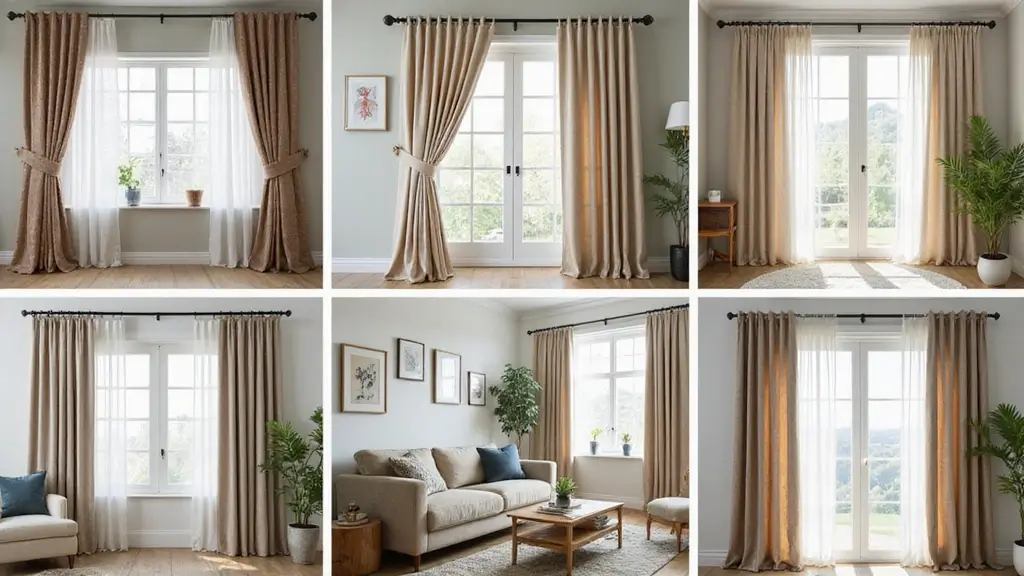
Why settle for a single curtain when you can master your living room’s mood? Layering sheer curtains with blackout panels gives you complete light control throughout the day. You’ll position the sheers closest to your window—they’re typically crafted from linen, cotton, or silk blends that diffuse sunlight beautifully while maintaining daytime privacy. Mount blackout panels on the outside to block light completely when you need darkness for movie nights or rest. These window treatments use tightly woven linings to eliminate unwanted brightness. You can also mix velvet or linen with your sheers to add texture and depth without sacrificing functionality. This layered approach lets you adjust privacy and illumination instantly, adapting your space from bright and airy to cozy and secluded with a simple pull.
Recommended Products

Pair Sold: Each package includes 2 panels of blackout curtains. Each panel measures 40"W x 63"L, with a pair measuring 80"W x 63"L.

100% Blackout Curtains: Our Blackout Curtains ensure a completely dark room, isolate noise and protect privacy. These room darkening curtains can block 100% sunlight.Heavy duty curtains keep heat indoors in winter and discharge heat in summer, thereby reducing cooling and heating costs , While protecting your furniture, floors and artwork from the sun damage

100% Total Blackout & UV Blocking: Achieve perfect darkness with these blackout curtains! The dedicated liner blocks 100% sunlight and UV rays, ideal for any bedroom or living room. This blackout curtain protects furniture from fading and helps regulate room temperature year-round.
Select Hardware That Fits Your Room’s Style
Your layered curtains deserve hardware that’s equally thoughtful. Select curtain rods and decorative hardware from Amazon, West Elm, Pottery Barn, Crate & Barrel, or Anthropologie that match your room’s style—whether traditional or modern. Pair hardware finishes like brushed brass, matte black, or polished nickel with your curtains to reinforce your intended aesthetic. Choose finials that echo your design mood: sleek geometric shapes for contemporary spaces or ornate details for classic interiors.
Mounting height matters. Position rods 4–6 inches above your window frame so curtains graze the floor or hover ½ inch above for a polished look. Extend rods 3–6 inches past each side for architectural balance. Select hanging styles—rod-pocket, grommet, tabs, or rings—that align with your desired formality and influence how your hardware reads in the space.
Recommended Products

SET DETAILS: 2 panels per package. Each panel measures 52 inch wide by 54 inch long with 8 silver metal grommets (1.6 inch inner diameter) on top, easy to install and slide.

Ready Made:Package includes 2 panels of double layered blackout and sheer curtains with tie backs,measuring 54Wx95L inch each panel,1.6inch grommet top.Recommend to order 2-3 times rod width for proper look and fullness.

Size & Specification: Each pack contains 2 panels curtains. Each curtain is 40" wide and 54" long, total width is 80", total length is 54". The curtains are designed with rod pockets that fit curtain rods up to 1.5 inches in diameter
Hang Curtains High and Wide to Maximize Your Windows
When you mount curtains high and wide, you’re not just dressing a window—you’re manipulating perception. This window treatment tricks the eye into seeing larger windows and taller ceilings.
Start by hanging high: position your rod 4 to 6 inches above the frame, drawing sightlines upward. If ceilings are low, place it above the trim for an elevated effect. For rod placement, extend 3 to 6 inches beyond each side. This lets wide curtains stack back completely, flooding your space with natural light and preserving views without sacrificing light and privacy.
Got tall, multi-pane, or clustered windows? Double up panels at the outer edges. You’ll maintain that expansive visual footprint while keeping functional control. Master these techniques, and you’ll maximize every window’s potential.
Recommended Products
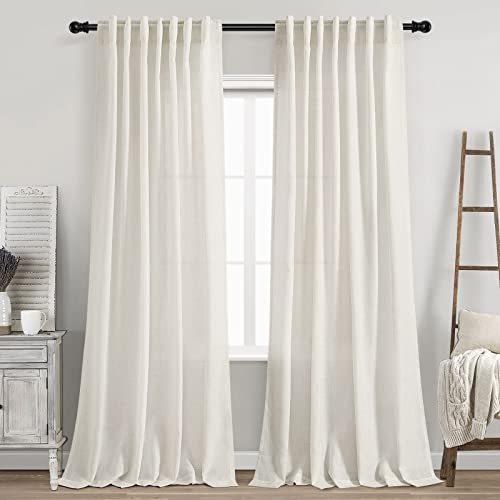
READY MADE: 2 Linen Curtain Panels per package.Each panel measures 52 inches wide by 84 inches long. Top design of Back tab & loop pocket provide 3 hanging options. <1> hanging from the back patch to create an elegant pleated look, <2> from the 3 inch rod pocket for a classic look <3> Hanging with clip rings for easy, slide open and closed (clip rings are not included)

WELL MADE: Sold as 2 panels, each panel is W52" x L90", and W104" x L90" in total. Each curtain panel has 2-in-1 top style design: rod pocket and back tab. With 3-inch inner diameter fit most standard rod. Curtains also can be hung with clip rings. 3 ways meet your various needs.

Package: The package includes set of 2 natural linen curtain panels. Each linen textured curtain measure 52 inch wide and 63 inch length. Each light filter curtain has 8 vintage bronze grommets with 1.6-inch inner diameter, fit well with most rods. Easy to hang, and slide smoothly.
Add Pleats, Ties, or Holdbacks for a Polished Finish
Once you’ve positioned your curtains to expand the room’s proportions, it’s time to refine how they behave and look when drawn. You’ll select pleats—pinch, pencil, or ripplefold—to shape each curtain panel’s drape and formality while ensuring smooth operation with your chosen rod system. Your fullness ratio determines how densely these pleats gather, directly influencing light control and view visibility.
You’ll secure open panels using tiebacks or holdbacks, creating structured, tailored shapes that maximize natural light. Consider hardware visibility carefully: concealed tiebacks blend seamlessly with fabric, whereas decorative holdbacks become deliberate accents. When layering treatments, ensure wide enough holdbacks to fully expose sheer or blackout layers without bulky obstruction at the window face, preserving your polished finish.
Recommended Products
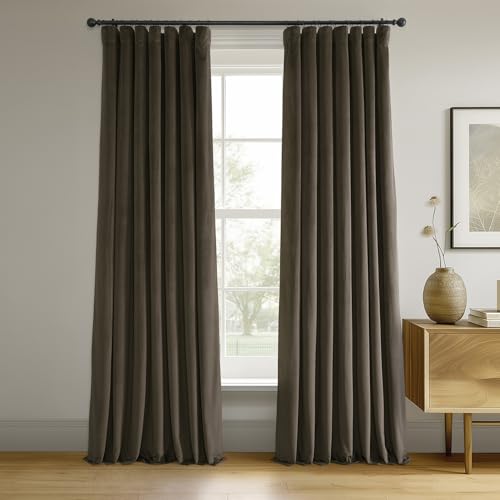
How To Hang: Our header allows you to hang 3 ways. Curtain panels can be sheered on a rod using the pocket, Hang with back tabs or attached to rings using the belt and drapery pins. Pole Pocket will accommodate a pole up to 1.5 inches, Hooks Not Included.

Package Includes: 2 caramel soft crushed velvet curtain panels. Each curtain panel measure 52 inch wide by 96 inch length, with 3” rod pocket. Rod pocket top designed curtains can be hung on rod or with curtain clips (not included), creating different style easily.These hanging options will offer you flexible home decoration.

LIGHT CONTROL - This lined curtain panel is considered a Blackout, blocking 100% of the light. The Thermal Insulated lining ensures complete privacy blocks out sunlight and reduces heat and noise.
Skip These Living Room Curtain Sizing Errors
Why do so many living rooms feel visually off despite expensive furniture? You might be making common curtain sizing mistakes that throw everything off balance.
When selecting curtains for living room spaces, you need to nail your measurements. You should plan panel width at 2 to 3 times your window width—so a 60-inch window demands 120–180 inches total fabric for proper fullness/folds. Don’t skimp here; skimpy panels look cheap and flat.
Your window treatment height matters enormously. You must hang your curtain rod placement 4 to 6 inches above the frame and extend it 3 to 6 inches past each side. This trick creates taller, grander windows and lets panels fully clear the glass.
Finally, avoid the dreaded high-water look. You’ll want floor-length panels hovering ½ inch above the floor, never stopping short. Puddled lengths work too, but require extra maintenance.
Recommended Products

Talia Double Layer Sheer and Room Darkening Blackout Indoor Curtains 2-Pack

Basic Information:The grommet top has an inner diameter of 1.6 inches. Each curtain panel is available in 35-inch and 52-inch width options. Available lengths: 63 inches, 72 inches, 80 inches, 84 inches, 90 inches, 95 inches, 102 inches, 108 inches, and 120 inches. Each set includes 2 detachable tiebacks.

100% Blackout: Designed with a specialized shading layer, these Blackout curtains 100% block out light while providing thermal insulation, noise reduction, and total privacy—making them the perfect choice for night shift workers, light sleepers, or anyone seeking a peaceful, undisturbed environment
Match Your Curtains to Living Room Architecture
Getting your measurements right solves only half the puzzle; your curtains also need to work with what’s already built into your space. Arched windows demand particular attention—you’ll want to preserve their character while managing practical needs.
For living rooms, leave arched windows bare to maintain visual focus on the architectural feature itself. When privacy and light control become essential, mount a café curtain beneath the arch rather than covering it completely. You’ll achieve architectural harmony without sacrificing function.
If you’re dealing with multiple statement elements, check your proportion and scale carefully. Select a curtain rod that complements rather than competes with curved lines. Keep fabric weight balanced against the arch’s presence. You’re aiming to enhance what’s already beautiful, not create competition for attention.
Recommended Products

Forest Hill panels offer a contemporary branch motif on a linen look woven blackout fabric
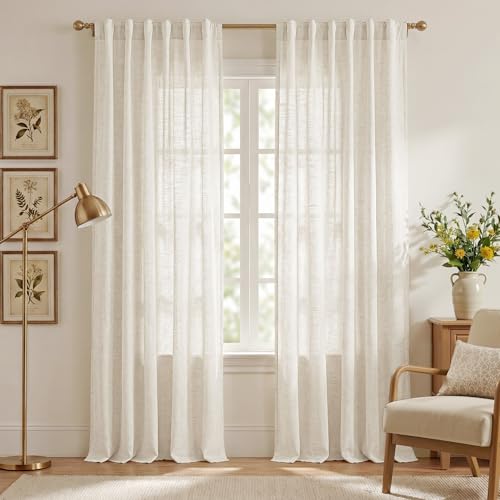
Ready-Made: 2 linen-blend curtain panels per pack, ready to hang. Rust-resistant metal grommets (fit most standard rods) + OEKO-TEX certification, non-toxic, skin-friendly—ideal for healthy, hassle-free window dressing.

Room Darkening: Enjoy a restful sleep environment anytime. Our high-density fabric panels are designed to block 85%-99% of incoming sunlight and UV rays (Light colors block 60-70%). Whether you’re a night shift worker, a light sleeper, or setting up a nursery, these curtains effectively dim the room to ensure you enjoy a deep, undisturbed sleep.
Conclusion
You’ve got everything you need to dress your windows beautifully. Measure carefully, balance light control with privacy, and let your curtains complement your space rather than compete with it. Hang them high and wide, layer thoughtfully, and don’t forget those finishing touches. Your living room will feel complete, polished, and perfectly yours.