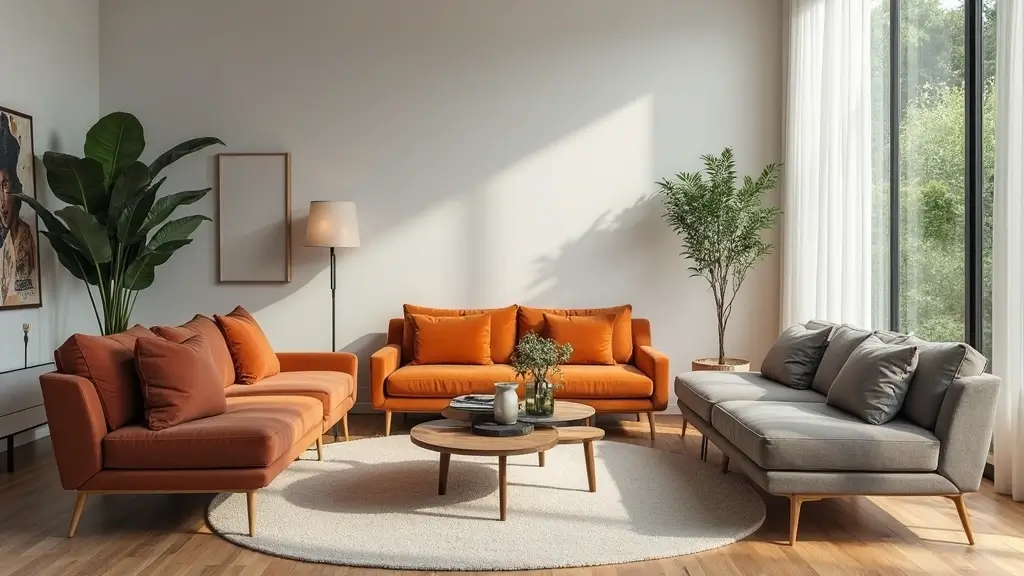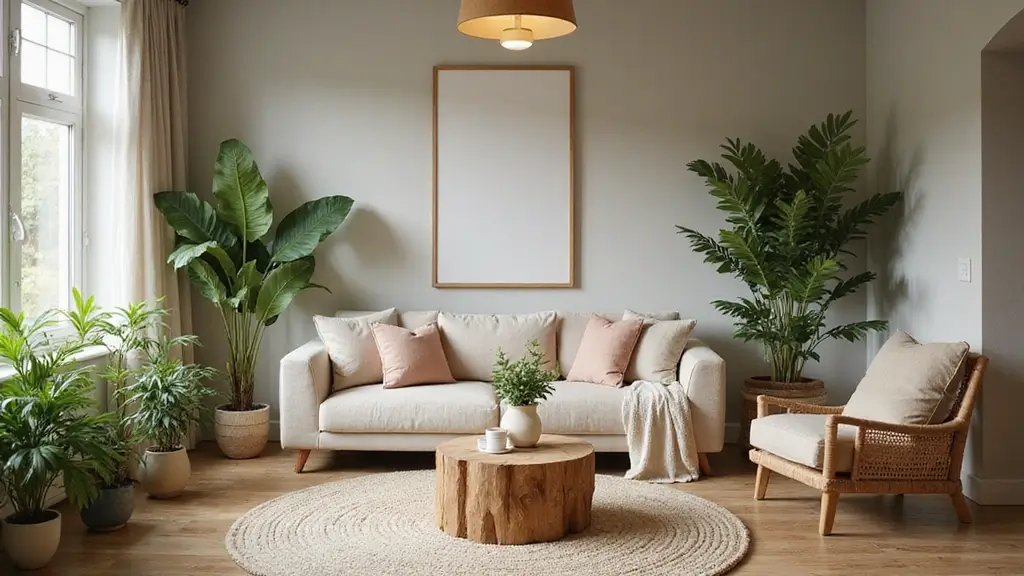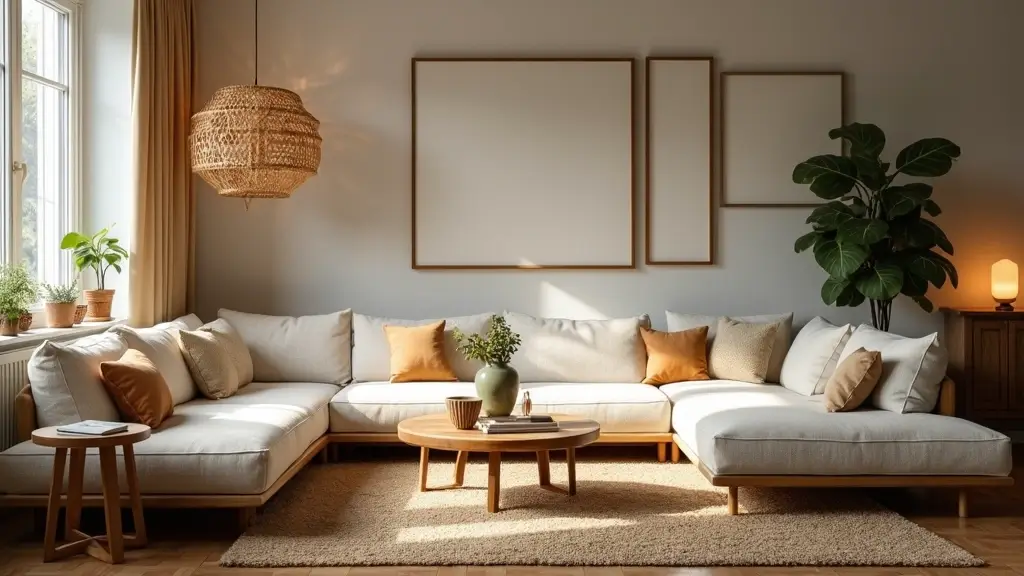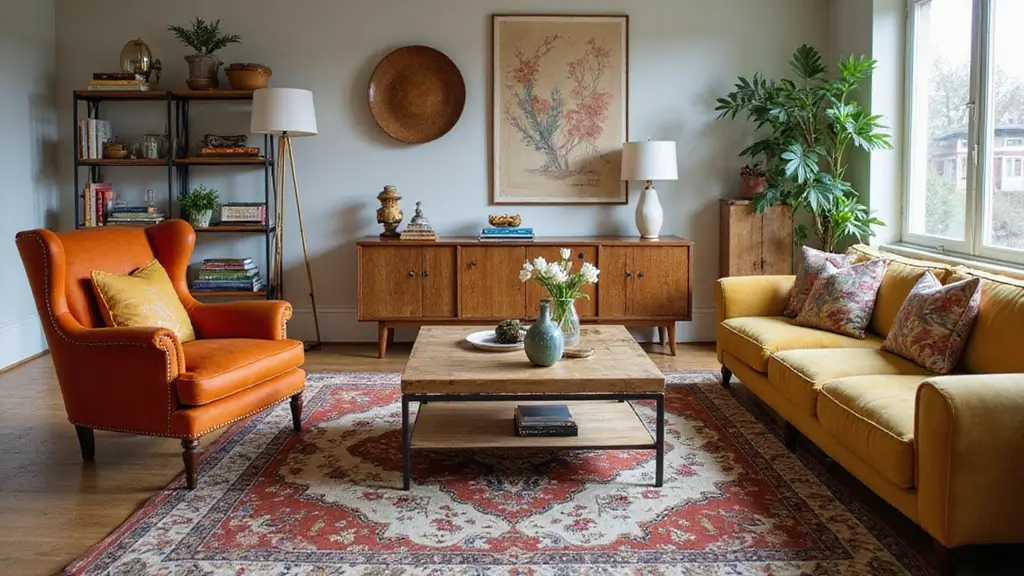

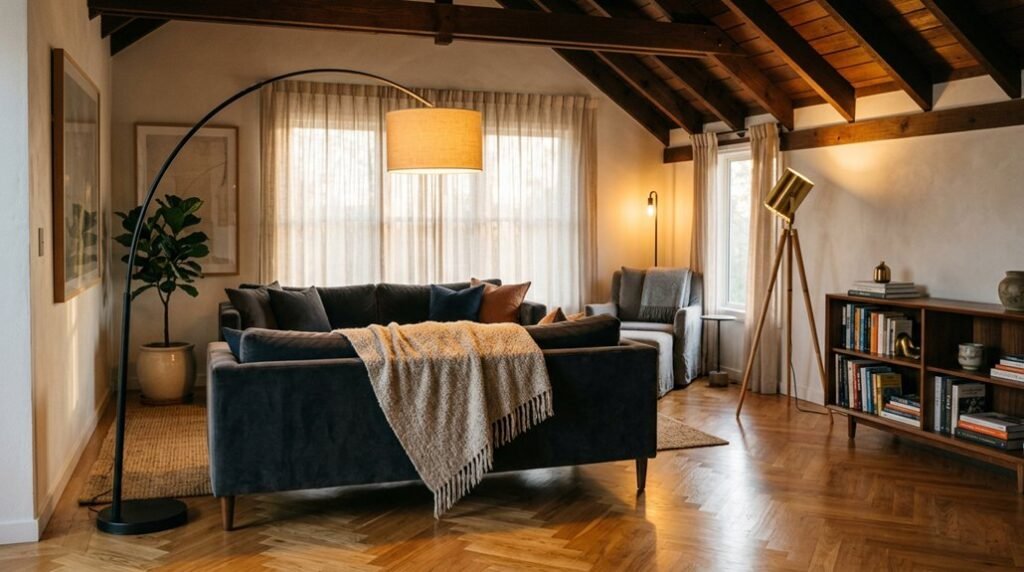
You stand in your living room and notice the lamp you’ve shoved into the corner isn’t doing much. The light pools uselessly against the wall while your sofa sits in shadow. You need a plan. Floor lamps can carve out intimate conversation areas, balance harsh window glare, or simply brighten where overhead fixtures fail—but only if you position them with intention. The difference between a room that feels layered and one that feels flat often comes down to height, shade direction, and whether you bothered to measure the clearance behind your sectional.
Where to Place Floor Lamps in Your Living Room
Where exactly should you position a floor lamp to transform your living room from dim to dimensional? You achieve this through strategic placement that balances ambient lighting with functional needs.
Position floor lamps behind the left side of your couch, angled diagonally over the lounge area, or tuck them into the left back corner where wall meets floor. These placements illuminate seating without obstructing movement through the space. You’ll want adjustable or tripod lamps with swivel heads and wide drum shades that disperse light evenly across corners, eliminating harsh shadows.
In open layouts, place floor lamps near windows or adjacent to seating to complement daylight and maintain consistent illumination as natural light fades. Layer your living room lighting by combining ambient floor lamps with overhead sources and wall sconces. This creates versatile, balanced illumination throughout the space.
Recommended Products
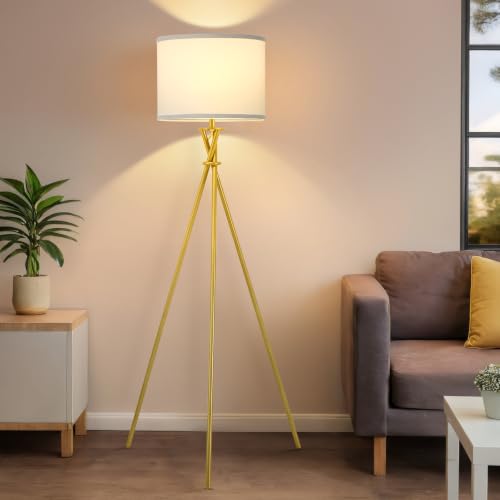
【Classic & Modern Tripod Floor Lamp】Made from premium, durable material built to last for years. At 61 inches tall, it is just the right height to allow for full room illumination. fits in any room from industrial to modern or traditional décor.

Make Sure Your Desired Size: Top: 16 inches, bottom: 16 inches, height: 9 inches, screw thread: 1.65 inches,drum lamp shade is suitable for E26 & E27. Please check the ring diameter of the light frame carefully before purchasing.
Next to Sofas and Chairs: Task Lighting That Works
How do you turn a sofa or chair into a proper reading nook? You position floor lamps next to sofas with surgical precision, creating task lighting that eliminates eye strain without casting shadows across your page.
Place adjustable lamps slightly behind or beside your seating, angling the shade to direct light downward while preserving sightlines across the room. You’ll minimize glare and maintain spatial flow. In corner arrangements, deploy wide-shade or tripod floor lamps with substantial drum shades to cast broad, even illumination across your lap and shoulders.
Scale matters: select lamps between 65–80 inches for lofty ceilings, ensuring bases don’t obstruct walkways. You must balance this task lighting with ambient lighting—layer overhead sources and install dimmers to modulate intensity. The result is a functional, visually cohesive zone where work and relaxation coexist seamlessly.
Recommended Products

Modern Fully Dimmable(0-100%) Floor Lamp & Convenient Rotary Switch: Compared with traditional Non-dimmable floor lamps for living room, our floor lamp is fully Stepless Dimmable, which suitable for all the room style and using situation ,find the perfect light for your needs. This standing lamp is very easy to turn on and off. Just simply twist it and then you can adjust the arc floor lamps brightness what you want. 4.1FT rotary switch, which is very convenient for you to adjust it.

Modern Floor Lamp with 0-100% Fully Dimmable Brightness :Compared to traditional non-dimmable living room floor lamps, our unique floor lamp offers a full stepless dimming function(0 - 100%), making it adaptable to various room styles and lighting requirements you need. This gold floor lamp has a convenient knob switch – simply twist it to customize your favorable lights of floor lamps for living room and bedrooms

Full-Range Stepless Dimming: Unlike traditional non-dimmable lamps, our floor lamp features seamless dimming from 0-100%. Turn the convenient knob to set the perfect brightness for any activity or mood in your living room or bedroom.
Behind Sectionals: Define Your Seating Area
Why let your sectional float aimlessly in an open floor plan? You’ll anchor your seating area by positioning floor lamp placement behind sectional arrangements, creating spatial boundaries without walls.
In open layouts, thin arc designs or modular silhouettes work best—you’ll maintain clear sightlines while avoiding obstructed movement paths. This behind sectional positioning generates ambient lighting that defines your territory visually and functionally.
You’ll optimize this placement by situating lamps near windows, where translucent shades blend daylight seamlessly into evening hours. The result softens transitions between natural and artificial sources, eliminating harsh glare.
Consider slender profiles that won’t crowd your sectional’s footprint. You’re not just illuminating; you’re sculpting space. Strategic floor lamp placement transforms undefined areas into deliberate, inviting zones where your seating area commands presence without overwhelming flow.
Recommended Products

Natural Marble Base: The GOEBLESON arc floor lamp for living room features a natural marble base with an eccentric rod structure. Unlike ordinary plastic or metal bases, the arc floor lamp with remote (lamp weight 13.67lb) is less likely to tip over when placed even on carpet, suitable for families with children and pets. Each marble base is different. These natural marble texture on the base makes each lamp unique

Magnetic Remote & Foot Control: GOEBLESON floor lamps for living room comes with a remote and a foot switch. The magnetic remote sticks onto the pole or any metal surface for easy access. The foot switch provides a convenient backup option to turn on/off quickly without reaching for the remote. The remote control standing lamp is such convenient for setting the smart lighting from the comfort of your couch or bed

3 Color Temperature Bulb Included: Dimension of this floor lamp is 60” height, diameter and height of lampshade is 10.04” and 7.87”, diameter of base is 8.66”. Includes a 9W LED bulb which has 3 different color adjustable temperature setting: 3000K/5000K/4000K. You can easily change the color temperature to set the overall ambiance of the room.
In Dark Corners: Fill Empty Spaces With Light
What happens to the neglected corners of your living room when the sun dips below the horizon? They sink into shadow, swallowing your square footage whole. You reclaim these dark corners with floor lamps positioned strategically behind sofa corners or at sectional ends, creating pools of ambient illumination that fill spaces rather than merely occupy them.
Select wide-shade or multiple-bulb fixtures—tripod floor lamps with large drum shades work exceptionally—to disperse light across angular voids. Scale matters: choose 65–80 inch heights for tall ceilings, 50–60 inches for lower ones. You’ll maintain proportional presence without obstructing pathways. Place lamps slightly behind or beside seating to eliminate glare while sustaining reading comfort. Complete your lighting layering by mixing these corner fixtures with overhead and table sources, ensuring even coverage that dissolves darkness completely.
Recommended Products

【Dimmable 3 Color Temperatures&Fully Adjustable for Light Direction】 Unlike standard lamps, our arched floor lights includes a premium Dimmable LED Bulb. Moreover, The bright lamp with 3 color temperatures (3000K Warm, 4500K Natural, 6500K Cool) and It can be curved horizontally up to 350° and vertically up to 90° to direct light to create the perfect atmosphere for movie nights, reading, or working.The lighting match any activity or mood instantly Memory function saves your last setting

White Modern Floor Lamp: This floor light fits in any room from industrial to modern or traditional décor. Its simple and elegant design can make it easy to place in any room of the house.

Classic & Modern Arc Floor Lamp: This arched floor lamp has smooth curves and delivers mid-century modern style to your space. Combining classic with modern appeal, the standing lamp fits seamlessly into any decor. The floor lamp is supremely versatile no matter where you place it, you could use it as a reading lamp,office lamp or lamp for living room.
Near Windows: Balance Daylight and Evening Glow
Where does your living room falter most as afternoon light retreats? You solve this by positioning floor lamps near windows to create seamless daylight balance that transitions into evening glow.
Place thin or arc designs behind your sectional or sofa along the window wall. You’ll avoid obstructing pathways while anchoring the seating area. Choose translucent shades that merge with natural light and eliminate glare on screens.
For corner placements adjacent to windows, select wide-shade or multiple-bulb lamps. These disperse ambient lighting evenly across the room’s depth. At 65–80 inches tall, your fixtures complement standard window heights and seating arrangements without visual awkwardness.
You orchestrate light that evolves throughout the day. Morning brightness gains partners; dusk arrives with prepared illumination. The result feels intentional, not improvised.
Recommended Products

Modern Floor Lamp with 0-100% Fully Dimmable Brightness :Compared to traditional non-dimmable living room floor lamps, our unique floor lamp offers a full stepless dimming function(0 - 100%), making it adaptable to various room styles and lighting requirements you need. This black floor lamp with white shade has a convenient knob switch – simply twist it to customize your favorable lights of floor lamps for living room and bedrooms

Dual Control via Remote or Footswitch: This arc floor lamp adopts a combination remote control and foot switch, assuring convenience for daily life. You can easily turn it on/off, adjust brightness, change colors or set timing modes by buttons, or connect this standing lamp to “Smart Home Light” APP, and control this rattan floor lamp with your phone (Max remote distance: 65ft/20m, 2 AAA batteries not included)
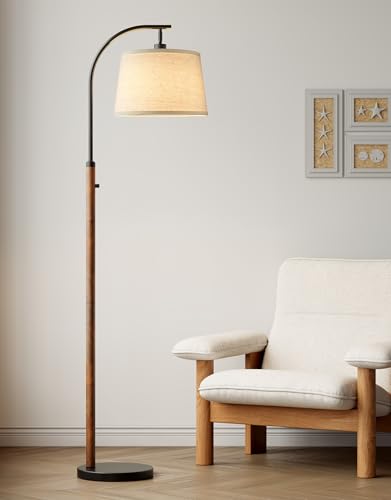
Full-Range Stepless Dimming: Unlike traditional non-dimmable lamps, our floor lamp features seamless dimming from 0-100%. Turn the convenient knob to set the perfect brightness for any activity or mood in your living room or bedroom.
Match Lamp Height to Your Ceiling and Seating
How do you keep a towering ceiling from swallowing your living room whole, or keep a low ceiling from pressing down? You match ceiling height to lamp height with precision.
For soaring ceilings above nine feet, you’ll select floor lamps standing 65–80 inches tall. These statuesque fixtures fill vertical space and anchor the room’s silhouette against tall windows or expansive walls. When your ceiling drops below eight feet, you’ll choose 50–60 inch lamps to prevent visual dominance and maintain breathing room above.
Seating alignment demands equal attention. You’ll position lamps so the shade’s bottom edge hits near eye level when you’re seated—approximately 60 inches from the floor. This placement eliminates glare during conversation or reading.
Adjustable lamps solve tricky spatial puzzles. You’ll fine-tune their height or swivel their heads to direct illumination precisely without disrupting sightlines across your arrangement.
Recommended Products

【Classic & Modern Tripod Floor Lamp】Made from premium, durable material built to last for years. At 61 inches tall, it is just the right height to allow for full room illumination. fits in any room from industrial to modern or traditional décor.

Make Sure Your Desired Size: Top: 17.5 inches, bottom: 17.5 inches, height: 10 inches, screw thread: 1.65 inches, beige large drum lamp shades is suitable for E26 & E27. Please check the ring diameter of the light frame carefully before purchasing

Make Sure Your Desired Size: Top: 16 inches, bottom: 16 inches, height: 9 inches, screw thread: 1.65 inches,drum lamp shade is suitable for E26 & E27. Please check the ring diameter of the light frame carefully before purchasing.
Pick Shades That Direct Light Where You Need It
Why settle for light that lands wherever it pleases when you can command exactly where it goes? Select shades that sculpt illumination with precision.
In corners, deploy a tripod floor lamp crowned with a large drum shade to cast even, shadowless pools that eliminate harsh hotspots.
Position lamps slightly behind or beside seating to direct light downward without glare striking your eyes.
For a reading nook, choose adjustable-arm fixtures that swivel to pinpoint task illumination exactly where pages demand it.
Near windows, you’ll want translucent shades that merge with daylight, softening contrasts between interior and exterior brightness.
Build layered lighting by combining multiple sources—each shade calibrated for its zone—so no corner languishes in darkness and no single fixture bears the burden alone.
Recommended Products

Natural Marble Base: The GOEBLESON arc floor lamp for living room features a natural marble base with an eccentric rod structure. Unlike ordinary plastic or metal bases, the arc floor lamp with remote (lamp weight 13.67lb) is less likely to tip over when placed even on carpet, suitable for families with children and pets. Each marble base is different. These natural marble texture on the base makes each lamp unique

Convenient Foot Dimmer: This arched floor lamp is controlled by a pedal dimmer switch on the power cord, offering 0-100% brightness to meet your daily lighting needs. No need to bend down or tiptoe to reach, a easy push with feet will enable you to cutomize the brightness from dim to bright, great companion for reading, working, leisure and resting.
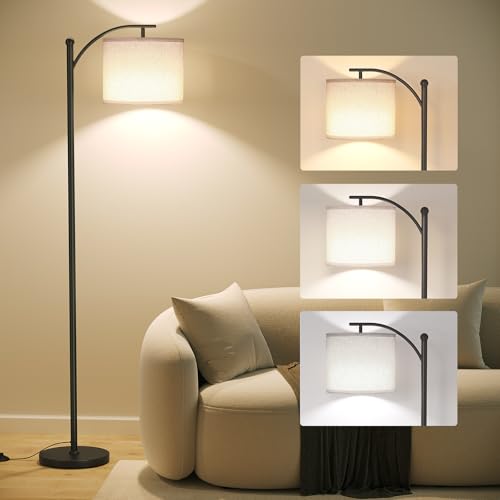
【3 Color Temperature LED Bulbs Included】SUNMORY Modern Floor Lamp includes a 9 watt,800 lumen, LED E26 bulb.This arc floor lamps bulb has 3 color temperatures that can be adjusted:3000K/4000K/5000K.You only need to press the foot switch to switch the arched floor lamp to different color temperatures, freeing your hands,black floor lamp can create different atmospheres for you.This floor lamp is perfect as a reading lamp,office lamp,or lamp for living room.
How Many Floor Lamps Does Your Room Need?
What dictates the number of floor lamps your living room demands? Room size governs your baseline: you’ll need one floor lamp per roughly 100 square feet to achieve layered lighting and balanced coverage. For a 300-square-foot space, position three strategically to eliminate shadows and anchor distinct zones.
Next, examine your placement requirements. You’ll fill dark corners and flank seating clusters, ensuring 36-inch clearance from traffic paths. Scale matters critically: select 65–80 inch lamps for high ceilings or 50–60 inch designs for constrained vertical spaces. In corner placements, you’ll deploy wide-shade or multiple-bulb configurations—tripod bases with large drum shades maximize diffusion. Adjustable arms let you direct task light precisely where you work or read.
Recommended Products

Multi Control Via Remote and App and Foot Switch: Eyassi arc floor lamp keeps your convenience in mind, dual control via foot switch and remote, you can easily adjust brightness, change color temperatures, set timing modes, and memory function by the remote buttons (Remote Distance: Max 65ft, 2 AAA Batteries Are not Included). Or you can connect this standing lamp with the “Smart Home Light” App and control the tall lamp with your phone

【Super Bright & Save Energy】Yikuneng bright floor lamp used advance high brightness LED, 18W LED floor lamp equivalent to traditional 200W halogen lamp, provide excellent lighting for reading, do homework, working, and breastfeeding without hurting your eyes. Save 90% energy mean save your money on electricity bill.
Quick Fixes for Common Placement Mistakes
Where exactly does your living lamp fall short—glare pooling off the page, shadows swallowing your corners, the lamp towering awkwardly beneath a low ceiling? You fix these placement errors by adjusting your floor lamps with spatial precision.
For reading glare, you reposition an adjustable-arm lamp slightly behind or beside your seat, directing light downward without searing your eyes. You illuminate dormant corners with wide-shade or tripod floor lamps, dispersing light evenly through large drum shades so shadows retreat.
Behind sectionals, you select thin arc designs—movement stays unobstructed while you define the seating zone.
Near windows, translucent shades blend with daylight, stabilizing your lighting scheme through changing hours.
You match lamp height to ceiling proportion: 50–60 inches for low ceilings, 65–80 inches for lofty ones.
Recommended Products

【Rotary Switch And Three Light Modes】: SUNMORY 3 lights arc floor lamp is configured with 3 light modes by convenient Rotary switch, light 1 light, light 2 light and 3 light by knob switch, different light modes allow you to have gentle ambient/accent lighting as well as intensified reading and work light. The E26 lamp holder can also be used with other types of bulbs below 60W, such as G25/ST58/A19/T45/RGB and so on. (Note: bulbs are not included in this arched floor lamps)

Dynamic lighting effect: Use the foot switch to turn on the light and select the mode with the remote control. You can also switch to speed mode for breathing/fast/flash color conversion to enhance energy, or choose your favorite color tone (7 colors) to create a romantic or imaginative atmosphere. Perfect for game settings, celebration or adding charm to your nighttime relaxation

【Stepless Dimmable & Three Color Temperatures】Rustic tall floor lamp comes with a 12W LED bulb, which could be adjusted lightness from 0-100% brightness and 3-color temperature settings ranging from 3000K-6000K as needed; This dimmable floor lamp also have pre-set modes offering various scenes such as: read, nursery, work and night light. It comes with a memory function, allowing it to recall the last lighting mode.
Conclusion
Place your floor lamps with intent: flank your sofa for reading, anchor a sectional’s back edge, or brighten a shadowed corner. Pair them with windows to layer daylight into evening warmth, and scale their height to your ceiling—taller for grand spaces, lower for intimate ones. Choose shades that direct illumination precisely where you need it. You will transform your living room into a balanced, functional sanctuary with light that moves as gracefully as you do.
Recommended Products

Full-Range Stepless Dimming: Unlike traditional non-dimmable lamps, our floor lamp features seamless dimming from 0-100%. Turn the convenient knob to set the perfect brightness for any activity or mood in your living room or bedroom.
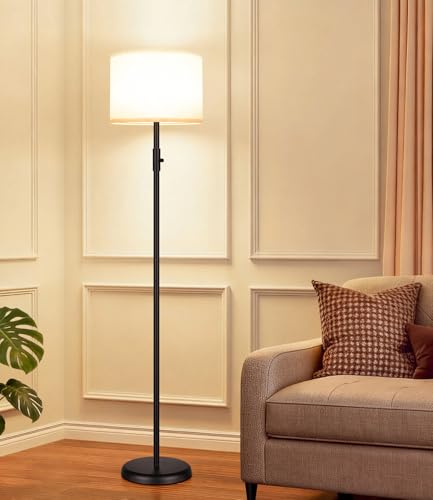
Stepless Dimming (0-100%) : Unlike traditional non dimmable floor lamps, our dimmable floor lamp features fully stepless dimming, making it suitable for various room styles and lighting needs. With a simple turn of the knob, you can easily adjust the brightness to your preference, whether for your living room or bedroom
![Nintiue [Upgraded] Dimmable Floor Lamp, 1000 Lumens LED Edison Bulb Included, Modern Arc Standing Tall Brown Floor Lamp for Living Room Bedroom Office Dining Room](https://m.media-amazon.com/images/I/41gILZcyUPL._SL500_.jpg)
Modern Fully Dimmable(0-100%) Floor Lamp & Convenient Rotary Switch: Compared with traditional Non-dimmable floor lamps for living room, our floor lamp is fully Stepless Dimmable, which suitable for all the room style and using situation ,find the perfect light for your needs. This standing lamp is very easy to turn on and off. Just simply twist it and then you can adjust the arc floor lamps brightness what you want. 4.1FT rotary switch, which is very convenient for you to adjust it.