

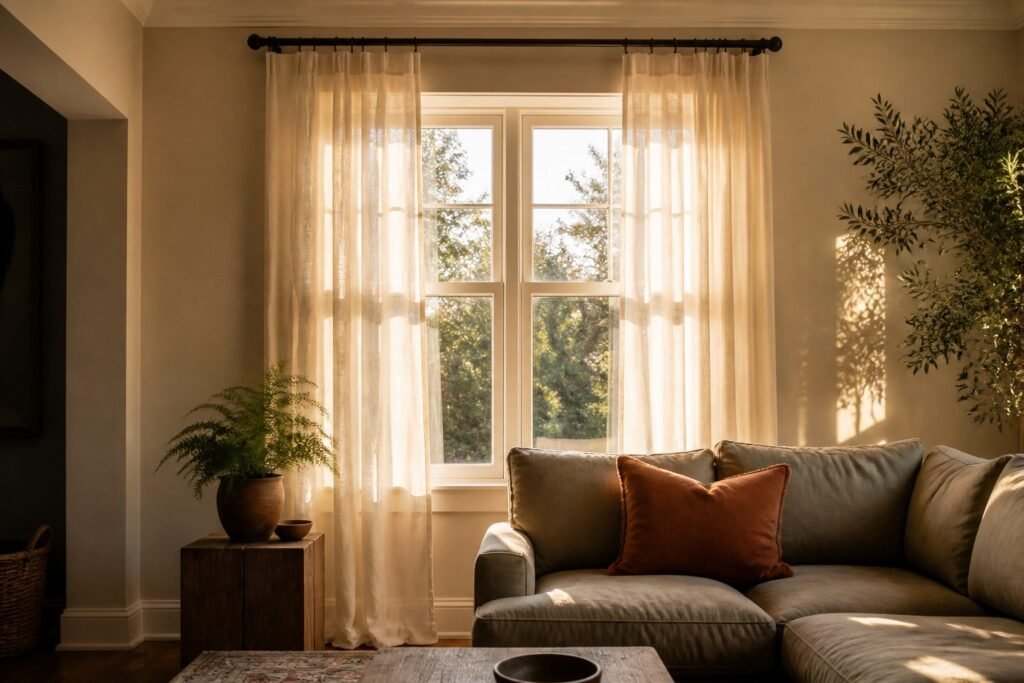
Curtain rods sit best 4 to 8 inches above the window frame, but that range collapses if your wall space is tight.
Less than 10 or 11 inches of clearance above the frame, and pushing for the full 8 inches leaves the rod crammed against the ceiling with awkward bracket placement.
I learned the hard way with 84-inch panels in a rental: the rod height and curtain length have to be chosen together, or neither one works.
How Many Inches Above the Window for a Curtain Rod

Curtain rods sit best 4 to 8 inches above the window frame, a range that covers most living rooms and bedrooms without fighting the proportions of standard 8-foot ceilings.
Six inches tends to land right; the curtains hang cleanly without brushing the trim or crowding the ceiling line.
Taller ceilings change the math. At 9 feet or more, shifting the rod to 8 to 12 inches above the frame, or within about 4 inches of the ceiling, stretches the wall vertically and gives the window more presence.
The same move works in small rooms where every visual inch counts: mounting closer to the ceiling draws the eye upward and keeps the space from feeling boxed in by the window box.
One detail that gets missed: keep at least 2 inches between the rod and the ceiling itself. Less than that, and the hardware fights the crown or the bracket placement turns awkward.
Measuring Your Window and Ceiling First

The space between your window frame and the ceiling is what actually decides whether the standard advice works in your room.
Grab a tape measure and check from the top of the frame straight up to where the wall meets the ceiling.
Aim for 4 to 8 inches above the frame if you have the room; that is the range most guides label as the safe default for standard 8- to 9-foot ceilings.
But the tape measure tells you when that default is not possible.
If you are working with less than 10 or 11 inches of wall space up there, pushing for the full 8 inches can leave the rod crammed too close to the ceiling.
The rule I follow here is to keep at least 2 inches between the rod and the ceiling itself, no matter the ceiling height.
In a tight space, 4 to 6 inches above the frame still reads as intentional; anything closer starts to look like a measurement that got away from you.
Taller walls change the math again.
In a large living room with high ceilings, 6 to 8 inches above the frame is still the starting point, but the window can start to feel disconnected if the rod sits too low on a vast wall.
Step back and look at the whole wall area above the window. If the proportion feels off, nudge the mark upward gradually until the window looks anchored rather than floating.
Keep every window in the room at the same height, even if the ceiling line varies; matching rod lines matter more than matching distances from the frame.
Marking the Rod Height and Checking Curtain Length

A pencil mark on the wall is only as good as the curtain that has to reach it.
I learned this the hard way in a rental with standard 8-foot ceilings, where a rod mounted at what looked like the right height left my 84-inch panels floating an inch above the floor like a visual shrug.
The math is simple once you check it: mark the rod 4 to 8 inches above the window frame, then measure downward from that mark to where you want the fabric to end.
For 84-inch curtains on a typical 80-inch window, that 4-inch gap above the frame lands the hem right at floor level, give or take half an inch for hardware style.
Grommets and rings drop the fabric below the rod; rod pockets sit closer to it.
96-inch panels give you the ceiling-height look that tricks the eye into seeing a taller window, while 108-inch lengths work for puddling or especially tall installations.
The dry run saves the trip back to the store: thread one panel onto the rod, hold it at your marked height, and see whether you get the hover, the kiss, or an accidental puddle before you drill a single hole.
Bracket Placement and Installation

Bracket placement is where the math of curtain hanging turns into something physical on the wall.
I mark the left bracket first, then measure across for the right one, running a level between the two marks before anything gets screwed in.
The rod needs to extend 8 to 12 inches past the window frame on each side so the curtains can stack back without blocking glass or light. Anything less crowds the window and costs you daylight.
Many homeowners make the same mistake when hanging curtains: they mount the brackets for the curtain rod just 2 to 3 inches beyond the window frame and use a short rod.
That narrow bracket placement is the single fastest way to make a decent window look wrong.
For heavy curtains, drywall anchors matter more than the screws themselves; a bracket torn out of the wall costs an afternoon and a patch kit.
Once both brackets are secure and level, the rod drops in, curtains clip or thread on, and you step back to see whether the stack sits clear of the frame or whether you need to nudge the whole assembly outward.
Standard Rooms vs. Tall Ceilings vs. Small Rooms

The height you mount a curtain rod changes what the room feels like more than most people expect.
A rod hung too low drags the ceiling down with it; placed right, it can trick the eye into seeing space that was already there.
For standard 8-foot ceilings, 4 to 8 inches above the window frame is the practical range. That leaves enough wall to frame the window without crowding the crown or making 84-inch curtains look like highwaters.
In rooms with taller ceilings, 8 to 12 inches above the frame keeps the proportions from feeling stretched. The extra lift preserves the vertical line without shoving the rod into territory meant for crown molding.
Small rooms play by different rules. Mounting close to the ceiling, with only about a 2-inch gap, pulls the eye upward and borrows height the floor plan does not actually provide.
Your curtains still have to reach the floor, and standard 84-inch panels will float awkwardly above it.
| Room type | Rod height above frame | Ceiling gap | Curtain length needed |
|---|---|---|---|
| Standard 8′ ceilings | 4–8 inches | ~12–16 inches | 84 inches |
| Tall ceilings | 8–12 inches | varies | 96 inches or longer |
| Small rooms | Close to ceiling | ~2 inches | 96 inches minimum |
I have seen the same window look cramped and then generous just from moving the bracket six inches. The measurement that matters is not the frame; it is the relationship between where the rod sits and where the ceiling ends.
Curtain Lengths and How They Limit Rod Height

Ready-made curtain lengths decide how high the rod can actually go. With 84-inch panels and a rod mounted near the ceiling, you get a three-inch gap where the fabric hovers above the floor like a bad haircut.
The standard lengths are 84, 96, and 108 inches. Each one sets a hard ceiling on rod height if you want the curtains to do their job.
| Length | Best ceiling height | Rod placement vs. window | What happens if you push it |
|---|---|---|---|
| 84" | 8 ft (96") | ~4" above frame | Floats above floor; looks unfinished |
| 96" | 8 ft (96") | Near ceiling | Just kisses the floor; the tailored look most people want |
| 108" | 9 ft+ | Near ceiling or higher | Pools slightly; needs taller ceilings |
With 84-inch curtains on a standard 80-inch window, the rod sits only about four inches above the frame to reach the floor. That barely clears the molding.
The 96-inch length is what lets you mount higher and get the elongated look, assuming your ceilings are the common eight-foot standard. Anything above that, and 108 inches becomes the practical choice.
The mistake is buying the curtain first and figuring out placement later. These two numbers, rod height and curtain length, have to be chosen together or neither one works.
Why Higher Rods Make Windows Look Bigger

A curtain rod hung too low drops the ceiling with it.
Continental Window Fashions, which installs these professionally, sees this mistake constantly: customers initially want rods just above the frame, then change their minds once they understand how the eye reads height.
The bracket becomes a visual anchor. Set it low, and the wall compresses; set it higher, and the eye travels upward, reading the window as taller than it is and the room as larger overall.
Small rooms gain the most from this trick. Vertical space is often the only space you have, and a rod placed closer to the ceiling, as Deconovo recommends for compact rooms, stretches that dimension without moving a wall.
The effect is optical, but the square footage feels real. One video walkthrough puts it plainly: hang the rod as high as possible to make the room feel bigger and taller.
The limiting factor is curtain length.
A higher rod needs longer panels, and standard 84-inch curtains may fall short. Measure before you drill, or the illusion breaks at the ankle.
Stopping Light Leakage at the Top

Thick blackout fabric still leaves a bright band across the top of the window when the rod sits too close to the frame.
The gap between curtain and wall lets daylight spill over the header, and heavier weave only blocks what the panel actually covers.
Raising the rod 4 to 8 inches above the trim closes that gap with overlap, so the fabric extends past the glass rather than stopping at its edge.
In bedrooms and media rooms where light control matters, that overlap does more than any upgrade to the curtain itself.
If the ceiling allows, half to two-thirds of the distance between trim and ceiling works even better, though you want at least two inches of clearance so the panel does not bunch against the plaster.
When the rod is already up and light still leaks at the upper corners, the fix is not new curtains.
A simple valance or cornice across the top seals the escape route without replacing hardware. The fabric weight was never the problem; the coverage above the frame was.
Extending the Rod Past the Window Frame

The wall space on either side of your window is doing more work than most people realize.
Extend the rod 8 to 12 inches past the window frame on each side, and the curtains stack completely clear of the glass when you pull them open.
Shorter mounts at 2 or 3 inches beyond the frame crowd the window and eat into natural light, since the fabric has nowhere to go.
This width also trades a cramped opening for one that actually looks intentional.
The same 8 to 12 inches that lets light in full also lets the curtains frame the window like trim, not like fabric bunched against the edges because it has no room to retreat.
A rod that stops short of giving the stack-back space turns your open curtains into half-closed ones; the glass is technically exposed but the view reads as blocked.
For a standard window, that 8 to 12 inch extension per side means a rod total of 16 to 24 inches wider than the frame itself.
If your wall is tight, 8 inches still works. Where you have the room, 12 inches gives the cleanest result and the most light, and the difference between them is usually just a longer rod, not a harder install.
Renter-Friendly Rod Options

Tension rods that fit inside the window frame keep your walls untouched, but they cost you the height game entirely.
The curtains hang at frame level, which does nothing to stretch the window visually and blocks more light than an outside mount would.
A better rental workaround is the wraparound style with side extensions that let the fabric sit in front of the frame instead of inside it. That preserves the window’s full width and reads more finished from the street.
For lightweight fabrics, adhesive heavy-duty hooks can carry the rod without a drill.
Plan on two or three hooks per side if the span is wide; the strip backing has limits, and a sagging center is what tells everyone you cheated the install.
Sheers or unlined linen stay up fine this way. Velvet or blackout material usually demands more support than adhesive can safely offer, and a hook tearing loose mid-afternoon will take paint with it.
Tap-in brackets that bite into the wooden window trim with a hammer solve the sturdiness problem.
The height is fixed: the rod sits where the frame sits, so ceiling-height drama is off the table. For many rentals, that trade is worth it.
Frequently Asked Questions
How many inches above window for curtain rod?
Mount the rod 4 to 8 inches above the window frame for most rooms with standard 8-foot ceilings.
This range clears the trim without crowding the ceiling and works with common 84-inch curtain lengths. Keep at least 2 inches between the rod and the ceiling itself so brackets install cleanly.
Should I hang curtain rods all the way to the ceiling?
Ceiling-height placement works well in small rooms or anywhere you want to stretch the wall vertically, but your curtains must be long enough to reach the floor.
Standard 84-inch panels will float awkwardly above the floor if the rod sits near the ceiling, so plan on 96-inch curtains minimum for this look.
Leave about 2 inches between the rod and the ceiling so hardware does not fight the crown molding.
Why do my curtains leak light at the top even when the fabric is thick?
Light enters through the gap between the curtain and the wall, not through the fabric itself.
Raising the rod 4 to 8 inches above the frame lets the fabric overlap the glass instead of stopping at its edge, which closes that escape route.
In bedrooms where darkness matters, aim for half to two-thirds of the distance between trim and ceiling if your wall allows it.
Is it necessary to hang curtains 4 inches higher than the window frame?
Four inches is the low end of the standard range, not a hard rule.
Anywhere from 4 to 8 inches above the frame works for most 8-foot ceilings, and the exact spot depends on your ceiling height, curtain length, and how much wall space sits above the window.
The only fixed limit is keeping at least 2 inches between rod and ceiling.
How long should a curtain rod be for a 72 inch window?
Add 16 to 24 inches total to the window width, meaning the rod should extend 8 to 12 inches past each side of the frame.
For a 72-inch window, that gives you a rod roughly 88 to 96 inches long so curtains stack clear of the glass and do not block light or the view.
What is the best height to mount a curtain pole above the window?
The best height is 4 to 8 inches above the frame for standard 8-foot ceilings, or 8 to 12 inches above with taller walls.
The real deciding factor is the space between your window trim and ceiling: if you have less than 10 or 11 inches of wall there, push toward the lower end of the range so the rod does not end up cramped against the plaster.
Is it better to hang curtains above the window or at the ceiling?
Above the window is the safer default for most rooms, while ceiling placement suits small rooms or spaces where you want the eye to travel upward.
Ceiling mounting demands longer curtains, usually 96 inches or more, or the fabric will hover above the floor and break the illusion. Match the rod height to your curtain length, not the other way around.