
You need your art to sit where the eye naturally rests, but most people hang it too high. The standard 57-inch centerline puts the work at average eye level, though furniture placement and ceiling height throw off the formula. Get the measurement wrong, and your room feels off-balance no matter how good the piece is. There are specific fixes for each scenario, and you’ll want to know them before you drill.
How to Hang Art at the Right Height: The 57-Inch Rule
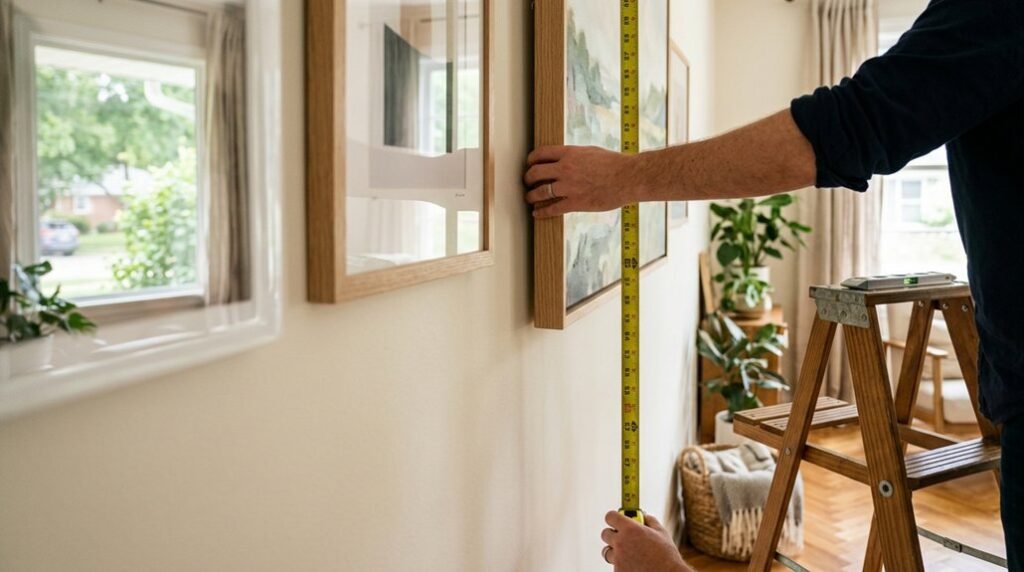
Where exactly should you position your wall art? You apply the 57-inch rule, aligning the artwork’s vertical midpoint at 57 inches above the floor. This center height reflects standard gallery guidelines and positions hanging art at average eye level. You’ll use a measuring tape to mark this point, then employ a level to ensure precision. The 57–60 inch range accommodates most spaces while maintaining consistent wall art height. Higher ceilings require minor upward adjustments, but you’ll preserve that central reference for visual balance.
When hanging multiple pieces, you center the entire arrangement around the same 57–60 inch mark, creating a cohesive display. A second observer helps verify alignment across your installation.
Recommended Products

Design: Featuring three classic ponies in soft pastel colors with flowing rainbow manes and sweet expressions, the artwork is set against a dreamy lavender background.

Design:Handwoven cotton rope macrame wall hanging in navy blue, adding depth, texture, and a calm visual focal point to elevate any interior space.

Showcase Your NFL Team: Proudly display the San Francisco 49ers name, helmet, and iconic team logo, perfect for any NFL fan looking to represent their favorite team.
How High to Hang Art Above Furniture
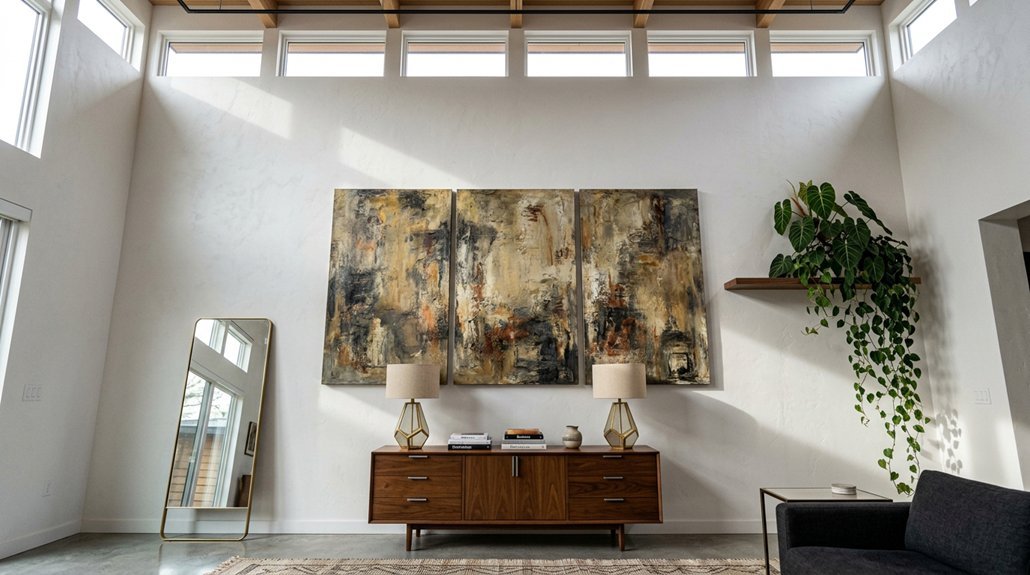
The 57-inch rule shifts when you position art above furniture. When you hang wall art above furniture, target 5–7 inches between the frame’s bottom edge and the top of furniture. You’ll maintain visual connection without crowding.
For low consoles or sofas, use six-inch spacing, adjusting based on furniture height and artwork size. When you’re measuring larger pieces, align the top closer to eye level while keeping the bottom within that gap. Tall furniture demands tighter spacing—about four inches—to preserve cohesion from a seated view.
You achieve balance by centering each piece with the furniture’s midpoint. Consistent hanging height ensures the vertical relationship reads correctly from standard viewing distances. While a gallery wall follows different logic, single art above furniture requires this disciplined approach to spacing and proportion.
Recommended Products

Reads fractionally on left side from 0 to 80 Inch, in continuous inches and inches-and-feet

Track Your Child’s Growth - Let a growth chart for the wall help you keep track of all of your child’s height milestones, from birth to adulthood

Exclusively Premium Materials: Crafted from top-grade, thick, resilient, and waterproof canvas encased in a wooden frame, our kids measuring chart for wall guarantees unmatched quality. It's crafted to be safe, non-toxic, and eco-friendly, ideal for your child's room. It boasts a material that's easy to write on, where you can use dark colored ballpoint pens, sharpies and markers to track growth milestones effortlessly.
Gallery Walls: Center the Whole Arrangement
When you’re curating multiple pieces, approach a gallery wall as a single unit rather than isolated frames. Establish a centered gallery by treating the entire wall art grouping as one cohesive arrangement. Set your overall center height at 57–60 inches from the floor to the midpoint of the entire cluster. Apply center-focused hanging: even in vertical configurations of three pieces, align the central frame to this reference line. Maintain 2–3 inches of group spacing between frames to preserve visual balance and prevent fragmentation. Ensure top-to-bottom alignment stays within consistent bounds—avoid staggering extremes that disrupt the unified field. When chair rails intersect the display, adjust the gallery wall height relative to the rail, but don’t abandon the centered alignment principle. This disciplined approach delivers visual balance across any wall art grouping you compose.
Recommended Products

CANVAS WALL ART SIZE:29x58 inch,due to the fact that the product is handmade, there may be an error of 0.1 to 0.2 inches.

Exclusive New Material: Breaking the traditional canvas manufacturing process, innovatively using acoustic polyester fiber panel which brings a new feature to the wall sign - sound absorption. In addition to aesthetics and decoration, the wall plaque can also purify the sound environment and create a quiet and comfortable space

Exclusive New Material: Breaking the traditional canvas manufacturing process, innovatively using acoustic polyester fiber panel which brings a new feature to the wall sign - sound absorption. In addition to aesthetics and decoration, the wall plaque can also purify the sound environment and create a quiet and comfortable space
High Ceilings and Hallways: When to Adjust
Why should standard center heights bend to accommodate narrow passages and towering walls? In hallways, shorter viewing distances demand adjustment. You raise the center height to 60–66 inches, preventing awkward crane-neck angles while maintaining eye level comfort. High ceilings introduce different constraints. You center at 57–60 inches, but the room’s scale permits higher placement when space balance requires it. For gallery walls in tall spaces, you treat the entire arrangement as one unit, establishing a single central reference rather than calculating individual piece centers. Crown molding or architectural rails force recalibration—you anchor the center height relative to these fixed features. When working with oversized pieces, you extend vertical arrangement upward, keeping group boundaries visually unified while exploiting the wall’s full height potential. Precision preserves proportion.
Recommended Products

MULTI-PHOTO WALL DISPLAY: Display your favorite photos in an eye-catching fashion using these hanging, gallery-style frames suspended from a modern and sleek beam; holds four 5x7 and five 8x10 photos

A GALLERY WALL TO IMPRESS: Create a feature wall that your guests will want to copy. The Kate and Laurel Bordeaux Frame collection allows you to design a display that not only will add style to a blank wall but will also give you the warm glow of your treasured memories and enhance any room
Art Size and Hanging Height: Getting the Scale Right
How does scale reshape your hanging strategy? For standard pieces, you’ll center artwork at 57–60 inches—this eye level anchor lets you adapt scale across wall space. When hanging above furniture, you’ll position the bottom edge 4–8 inches above the piece, typically near 6 inches, to achieve balance between art and furnishing.
For a gallery wall, you’ll treat the collection as one unit with a unified center at 57–60 inches, spacing frames 2–3 inches apart. Tall ceilings permit slightly higher hanging height, but you’ll avoid forcing neck-craning; hallway displays work at 60–66 inches for improved viewing distance.
With larger artwork size, you’ll lower the top edge so the center holds at eye level. You’ll maintain balance with surrounding elements, letting scale—not guesswork—dictate placement.
Recommended Products

Wide Assortment: 220-piece picture hanging kit includes 24 sets of 10lb picture hangers, 14 sets of 30lb picture hangers, 4 sets of 50lb picture hangers, 3 sets of 100lb picture hangers, 2 sets of 80lb, and 2 sets of 120lb picture hangers, 8 sets of D-rings, steel wire, screw eye hooks, and sawtooth hangers

Package Included: 2 Sets Large Frame Hanging System (Each set includes 1 mounting pieces(180 degree rotary), 2 meter stainless steel cable, 1 adjustable hook)

Sufficient to Use: there are 10 white picture rail hangers, 10 invisible nylon cords and 12 adjustable hooks (2 styles, J shaped and D shaped, 6 pieces for each style), which are enough to meet your use and replacement
Conclusion
You’ll hang most art with its center at 57–60 inches for optimal viewing. Above furniture, position the bottom edge 4–8 inches up, centered on the piece below. Treat gallery walls as one unit, keeping 2–3 inches between frames. Adjust for high ceilings or narrow spaces by slightly raising the arrangement. Always scale height to the artwork’s size—larger pieces can sit lower, smaller ones higher—to maintain visual balance and proper sightlines.
Recommended Products

Unique Dip-Dyed Fiber Art: Macrame wall hanging is one of a kind dip-dyed fiber art decor tapestry, made of natural macrame cord cotton thread composition five forming a symmetrical U-shaped appearance

Style: Boho Wall Decor features an elegant gray color palette with rustic wood bead accents, blending beautifully with modern wall decor, farmhouse decor, minimalist, and Scandinavian home styles.

Style: Macrame wall decor features a modern bohemian design with layered fringe and natural wooden bead accents, creating a soft, artistic look.