
You unroll your new rug, and the edges curl defiantly, disrupting the clean sightlines you envisioned. Memory in synthetic fibers or the tight roll of shipping fights your patience. You could force it now, but the geometry of proper acclimation matters more than urgency. The solution lies in controlled pressure and thermal equilibrium—not brute force, but calibrated restraint. What follows preserves both the weave and your warranty.
Why Your New Rug Is Curling (and How Long Until It Lies Flat)
Why does your new arrival arrive already yearning to curl skyward? You’ve encountered initial curling, a structural memory of your rug’s cramped roll/ crease confinement during transit. Corners curling betray tension still trapped within fibers desperate to expand.
Rug flattening demands patience. You’ll acclimate rug to ambient conditions, allowing thermal and moisture equilibrium before intervention. Weighted flattening accelerates this—broad, heavy objects compressing memory into submission, teaching edges to lay flat. Stubborn sections yield to reverse rolling, counter-flexing the grain, or the steam method’s gentle thermal persuasion (maintain distance, test discreetly first—fibers scorch easily).
The time to lie flat varies: denser weaves resist longer. Anticipate two to seven days for full relaxation. Your aesthetic emerges through disciplined technique—measured pressure, thermal coaxing, and the restraint to let materials settle into their intended plane.
Recommended Products

Instant Fix for Curling Rug Corners: These rug grippers feature a unique V-shape design that instantly secures rug corners, helping prevent curling, twisting, or lifted edges for a seamless look

STOP CORNER CURLING INSTANTLY: Keep your rugs perfectly flat with our specialized rug gripper system. It prevents rug corners from curling or rolling, instantly improving your home’s safety by removing trip hazards and providing a clean, polished appearance.

Instant Rug Stability: StepNGrip rug grippers instantly flatten rug corners to hold rug down; effectively prevents curling and slipping for a neat appearance and added safety in any space
Unroll and Let Your Rug Acclimate First
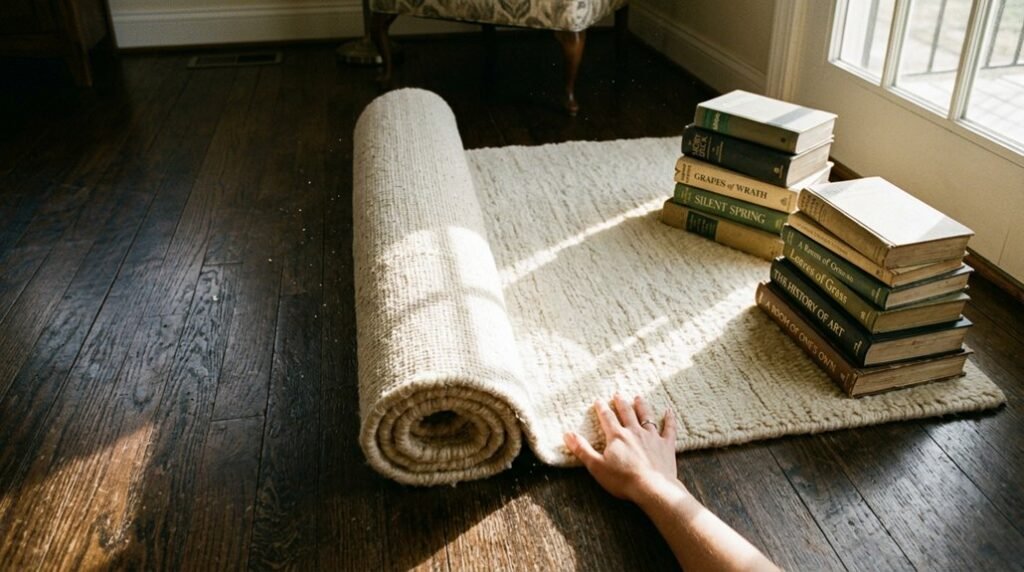
Where precisely should your rug awaken from its tubular confinement? You’ll unroll your unboxed textile in its intended destination, ideally atop its rug pad if one lies beneath. Should furniture eventually anchor it, select an open expanse that permits full unfurling. Lay it flat, then smooth the surface by hand—working against the grain of stubborn creases and coaxing curling corners toward submission.
Now you wait. Let the rug acclimate to room temperature for several hours before aggressive flattening attempts; fibers respond poorly to manipulation when cold or compressed. Give it a day or two, undisturbed, to settle into its dimensional truth. This patience prevents future warping and establishes the foundation for lasting planarity. The weave remembers how you first received it.
Recommended Products

GRIPPY - The last thing you want is a slippery rug. We added non-slip vinyl rubber dots to your rug backing fabric to prevent accidental slips and falls.

Value Pack for More Projects: receive 4 pieces of 80" x 40" non-slip rug backing fabric, providing more flexibility for multiple rug projects or DIY-sized designs; Save time and money compared with purchasing single pieces separately

Durable Material: Polyester fiber felt material, vinyl fabric with plum blossom pattern, this nonslip fabric appears to be fabric with vinyl pattern dots on the surface, durable and solid
Use Heavy Furniture as Weights (Safely)
Your heaviest pieces—sofas, credenzas, bed frames—become instruments of dimensional correction once the rug’s fibers have softened to room temper’ture. You’ll flatten stubborn rug edges by positioning these weights precisely where memory lingers in the weave.
Flip the textile; apply corner weights or heavy furniture directly to the back of rug along creased vectors, distributing load across broad surface areas to preserve pile integrity and prevent indentation trauma.
Layer rug grippers or pads beneath to anchor the composition against hard substrates while you work. Integrate dedicated corner weights for supplementary tension at lift-prone vertices. You’re monitoring progress across twenty-four to forty-eight hours, adjusting mass placement to achieve even flatness. Rearrange periodically—static pressure birth new wrinkles. Readjust, redistribute, refine until dimensional stability resolves.
Recommended Products

THE ORIGINAL EXTRA STRONG GRIPPER: our trusted Gorilla Grip nonadhesive rug pads offer a unique, dual sided grip that firmly holds onto both the rug pad and your hard floor to help prevent rug movement
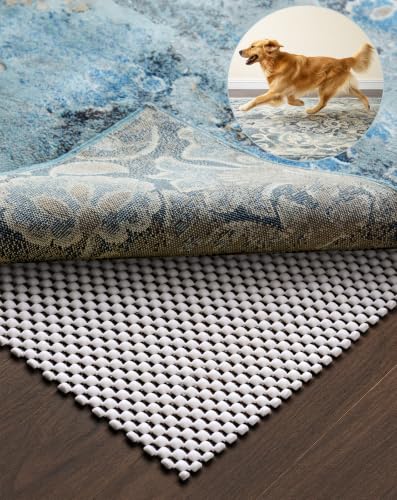
Non-slip Protection: Our pad's signature grip keeps rugs securely in place, preventing bunching and sliding during daily use. It also protects your floors from wear and tear, including damage from high heels, children at play, and more.

Grip Design: the original Gorilla Grip grippers for hard floors help to keep your rugs in place and prevent corner and side curling; easy to apply to the underside of carpet corners and floors to help rugs stay in place and flat against the floor
Speed Up Flattening With Weighted Objects
Pressure-applying objects accelerate dimensional correction when applied to creased topography. You’ll deploy heavy objects—coffee-table books, broad wooden panels—for weighted flattening that restores visual harmony.
Locate persistent creases and packaging signs; position weights directly atop these disruptions to impose even pressure across distressed weave. Target corners for edge flattening, ensuring each quadrant receives proportional attention. You must distribute weights deliberately, avoiding clustering that risks localized stress or floor abrasion. Select stable, slip-resistant bases to safeguard delicate fibers.
Monitoring progress defines rigorous rug care: inspect beneath weights every twelve hours, adjusting placement if secondary creases emerge. Maintain this regimen one to two days, gently smoothing between intervals. Through patient, methodical application, you’ll achieve resilient flatness—transforming manufactured tension into lived-in elegance.
Recommended Products

Floral High-Low Pile Design: Featuring a floral high-low loop pattern, this hallway rug runner adds rich 3D texture and farmhouse charm; the dimensional weave enhances visual depth, creating a warm and inviting space that elevates everyday home décor

Stylish Functional Aesthetic Rug: Easily enhance your space with Anidaroel whisper of the forest style chair mats! Crafted from premium printed fabrics, the pads are uniquely designed to add vibrancy and sophistication to any environment, such as offices, bedrooms and study spaces

Floral High-Low Pile Door Mat: This 3×5 area rug features varied pile heights for subtle 3D texture; floral design with neutral black&beige color suits various home décor, adding warmth and lasting style to your entryway
Reverse Roll Corners and Edges That Keep Curling
When weighted flattening leaves you with stubbornly curled corners and rebellious edges, you’ll employ reverse rolling to coax fibers into submission. You’ll reverse roll the rug by curling it opposite direction against its natural memory, forcing the pile to surrender its curling habit.
Roll tightly, securing the cylinder with string or rubber bands. You’ll let tension penetrate the weave for a day, allowing gravity and pressure to relax fibers from within. No tube? You’ll invert the rug entirely, achieving identical mechanical opposition against resistant edges.
Unroll deliberately, permitting the textile to breathe in ambient conditions before assessing its new posture. You’ll avoid crushing the surface with furniture prematurely. This method offers refined control—gentler than heat, more precise than mass alone. Repeat until your rug achieves flawless planarity.
Recommended Products

LIMESCALE-BUILDUP PREVENTION: This demineralized water is made for steam mops, stopping mineral deposits before they clog internal parts and diminish performance over time. It heats up faster than tap water, producing consistent, powerful steam that leaves stone and tile floors without streaks or leftover residue.

PREVENTS LIMESCALE BUILDUP: The demineralized water formula stops mineral deposits from clogging internal components and diminishing performance over time inside a steam mop tank. Heating up faster than plain tap water, it produces a consistent, powerful steam that leaves sealed floors without streaks after each cleaning pass throughout the home.

NOTHING LEFT BEHIND IN THE TANK: Tap water carries calcium and lime, and that residue collects on the heating element until steam output drops off. The minerals are already taken out of this water, so there is nothing to harden inside the machine. Start using it from day one on a steam mop and the tank stays clear from the first fill to the last.
Don’t Void Your Warranty Trying to Flatten Your Rug
How might you preserve both your rug’s pristine surface and its legal protections? You’ll safeguard your investment by honoring manufacturer guidelines before attempting any flattening technique. Debbie Crane warns that aggressive interventions risk warranty voiding, so you’ll prioritize non-destructive methods: patient unrolling, gradual acclimation, and gentle smoothing. You’ll document your rug’s material and care instructions, then contact the maker or retailer for professional advice on permissible procedures. When defects persist, you’ll pursue returns/exchanges rather than unauthorized treatments.
Your warranty demands restraint—steam and washing remain prohibited without explicit approval. You’ll favor time over torque, allowing natural fiber relaxation through controlled environmental exposure. Technical precision protects your textile’s integrity and contractual coverage simultaneously.
Recommended Products

ELIMINATE CURLING CORNERS: Instantly stop rug corners from rolling and curling out of place. Our rug gripper system keeps rugs perfectly flat, immediately improving your home’s appearance while removing dangerous trip hazards for a safer living space.

Advantaged Triangle Design: The Triangle Design grippers for area rugs and hardwood floors will maximum increase the contact surface. The strong adhesion will help stick firmly and keep your area rugs in place. Moreover, the rug stickers for wood floors will prevent the rug corners and edges curling and always keep your rugs steady and safe

NOTE: This gripper uses VACUUM TECH design which grips only hard smooth floors firmly and easily, it does not work for rug on carpeted floor. Also it does not work all rugs , it does not work for rubber backed rug ,jute rug or fluff backing rug , please check this. The adhesive surface can not be peeled once affixed on the rug.
Apply Gentle Steam or Heat the Right Way
Where conventional patience falters, controlled thermal intervention offers precision without peril. You’ll flatten your new rug by deploying gentle heat as one component of a comprehensive flattening plan, never the solitary remedy.
Activate your steam setting—handheld steamer or iron—and maintain generous distance from the rug fibers, sweeping slowly without touching down. You’ll test first: an inconspicuous corner reveals material tolerance before full commitment. When working the reverse side, shield with a damp protective cloth to buffer direct thermal transfer.
Steam coaxes tension from compressed weave, relaxes memory-locked creases. As rug fibers yield, you’ll position weights set flat across treated sections, securing the silhouette while cooling locks the form. This measured application of gentle heat transforms stubborn topography into plane geometry, disciplined and deliberate.
Recommended Products

Trustworthy Non Slip Material: made of polyester felt with a plum blossom pattern, this backing cloth offers a strong grip to keep your rug in place, ideal for pet friendly...
Anchor Your Flattened Rug So It Stays Put
Lock the plane you’ve sculpted against gravity’s slow reclamation. Place corner weights with wide, smooth surfaces on the back corners, distributing even pressure for one to two days. You’re anchoring memory into fiber, ensuring the flattening holds.
Combine these weights with a rug pad or Velcro grips beneath the weave to arrest movement under foot traffic. Recheck and adjust your weights; maintain a flat surface across the entire area.
If you spot edge lifting, secure with adhesive-backed corner weights or rug tape designed for hard floors. Keep weights in place during cooling, letting adhesive set fully.
Your rug breathes, settles, stays. The anchoring completes the architecture you’ve built.
Recommended Products
Unique Design: Do you still worry about the traditional glue rug tape harm your floor ? This gripper uses VACUUM TECH design which grips hard smooth floors firmly and easily, this design can protect your floor perfectly as no glue used on floor. But it does not work for rug on carpeted floor. It does not work for rubber backed rug ,jute rug or fluff backing rug.

Non-slip Protection: Our pad's signature grip keeps rugs securely in place, preventing bunching and sliding during daily use. It also protects your floors from wear and tear, including damage from high heels, children at play, and more.
Non-slip Protection: Our pad's signature grip keeps rugs securely in place, preventing bunching and sliding during daily use. It also protects your floors from wear and tear, including damage from high heels, children at play, and more.
Conclusion
Your rug’s final form emerges through patience and precision. You’ve coaxed fibers into submission, balanced moisture and weight, respected material limits. Now anchor those edges, step back, and witness how intentional technique transforms stored tension into grounded elegance. The curl is memory; the flatness, choice.
Recommended Products

Stylish Decorative Aesthetic Rug: Say goodbye to the drab and monotone! Unlike conventional clear plastic chair mat or black floor mats, the surface of anidaroel office rug is made of premium printed fabric, and it is designed to add a touch of beauty to your floor while complementing your surroundings seamlessly. Perfect for a variety of settings including offices, computer rooms, gaming rooms, bedrooms, and study spaces

Stylish Functional Aesthetic Rug: Easily enhance your space with Anidaroel whisper of the forest style chair mats! Crafted from premium printed fabrics, the pads are uniquely designed to add vibrancy and sophistication to any environment, such as offices, bedrooms and study spaces

[Stylish Decorative Aesthetic Rug] - Say goodbye to the drab and monotone! Unlike conventional clear plastic chair mat or black floor mats, the surface of anidaroel office rug is made of high quality printed fabric, and it is designed to add a touch of beauty to your floor while complementing your surroundings seamlessly. Suitable for a variety of settings including offices, computer rooms, gaming rooms, bedrooms, and study spaces.