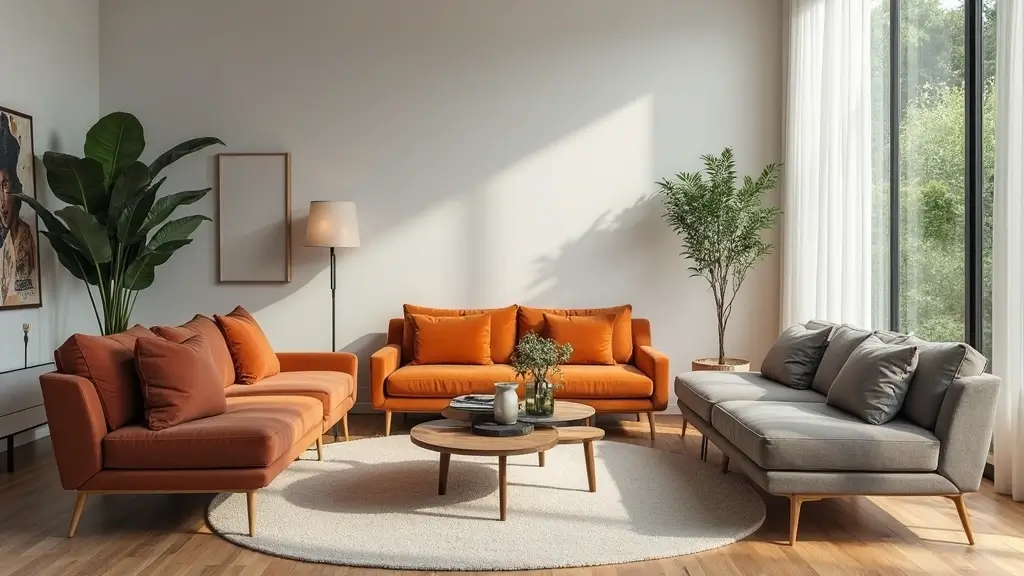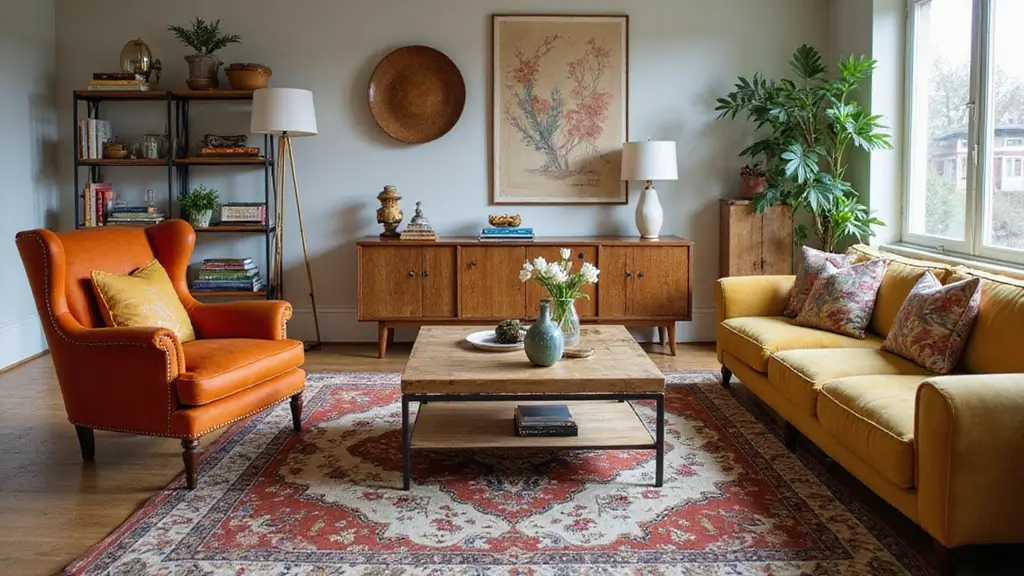

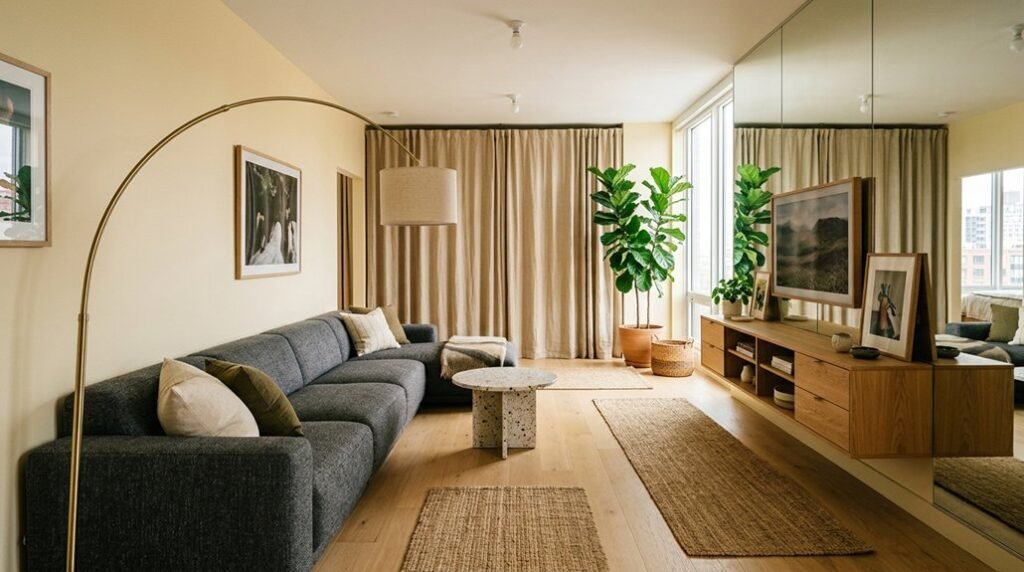
You walk into your long, narrow living room and immediately feel the walls closing in. Every furniture arrangement you’ve tried either blocks traffic or leaves awkward dead zones. The good news? You’re not stuck with a bowling alley aesthetic. With a few strategic moves, you’ll transform this challenging footprint into a space that actually flows. But first, you need to know which common mistakes are working against you.
Key Takeaways
- Anchor the room with a slim sofa placed against the shortest wall to create a visual crossbeam.
- Divide the space into distinct zones, such as seating and reading areas, to eliminate the tunnel effect.
- Choose furniture with exposed legs, slim arms, and low profiles to maintain open sightlines and flow.
- Place wide rugs perpendicular to the room’s length and add horizontal lighting across long walls.
- Hang one large mirror on a short wall and keep 30 inches of clear traffic space between pieces.
Recommended Products

Size: 1.5x5 ft/ 17.7x60 inch/ 45x152 cm. Low Profile. 0.4 inch thickness. Simple Elegant Moroccan Trellis Lattice pattern. A beautiful all purpose runner rug. Looks great on wood or tile floors

DURABLE AND PLUSH: Crafted from 100% Polypropylene, Long-lasting and sturdy jute backing (rug pad recommended), 0.39 inch rug thickness, meant for indoor use, perfect for high traffic areas, ideal for homes with childrens, fits under most doors

Machine Washable: 2x6 hallway runner rug is crafted from high-quality materials that are completely machine washable, making maintenance a breeze; Say goodbye to stubborn stains and odors, and enjoy a fresh, clean entrance rug effortlessly, ensuring your home stays inviting and well-kept without the hassle
Pick a Layout Strategy That Actually Works
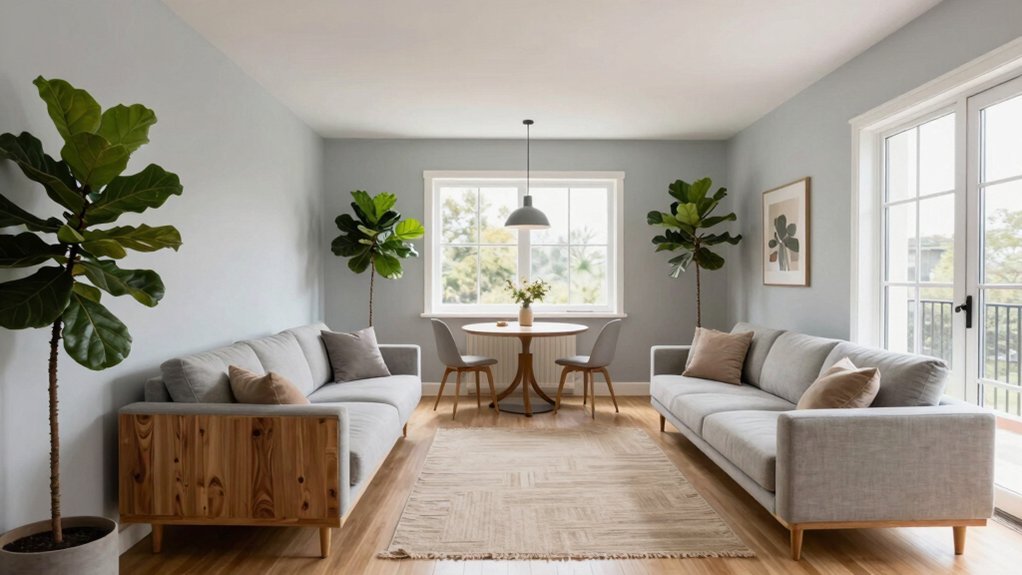
Layout is the make-or-break factor in a long narrow living room. You’ll need to pick a strategy before you buy a single piece of furniture.
You’ve got two solid approaches. You can divide the room into distinct zones—say, a seating area on one end and a reading nook on the other. This breaks up the tunnel effect and gives you functional separate spaces. Or you can embrace the length and create one continuous flow with a clear path down the middle.
Don’t mix these approaches halfway; you’ll end up with a cluttered, confused space. You should also consider traffic patterns now. You’re mapping where people walk so you don’t block circulation later.
Measure twice, sketch on paper, and you’ll avoid expensive mistakes.
Recommended Products
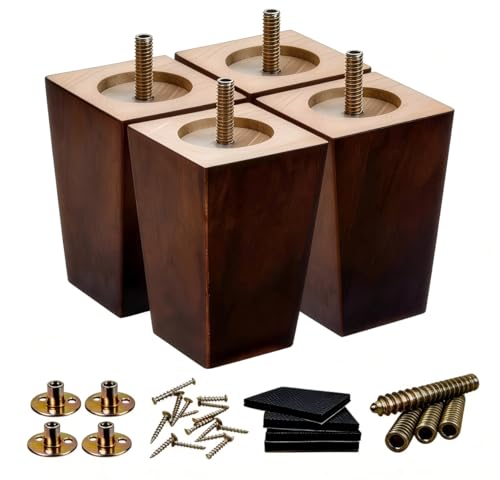
HEAVY DUTY LOAD CAPACITY — Precision-engineered solid rubberwood supports up to 1,762 lbs per set (440 lbs per unit). This 5-inch replacement provides a stable foundation for heavy sofas and preventing structural collapse without using subjective quality claims.

Crafted from natural hardwood with black finish, providing sturdy and reliable support for furniture pieces, they seamlessly blend with any decor style.

CHECK SIZE BEFORE ORDERING – Each leg is 6 inches tall with a tapered shape: 2.4 inches in diameter at the top (mounting end) and 1.4 inches at the bottom. These are replacement sofa legs designed for furniture with a flat bottom surface. If you are unsure about the height, measure the distance from your furniture's bottom frame to the floor before purchasing.
Place Your Largest Piece Across the Short Wall First
Where do you start when you’re staring down a room that feels more like a hallway? You anchor it. Grab your biggest piece—usually the sofa—and push it flush against the shortest wall. This single move breaks the tunnel effect immediately. You’re creating a width-first focal point that stops the eye from racing toward the back exit. Position the sofa’s back parallel to that short wall, letting it span as much of that width as possible. Now you’ve established a visual crossbeam that contradicts the room’s length. You’ll add smaller pieces later, but this anchor dictates everything: traffic flow, conversation zones, balance. Don’t float the sofa in the middle; you’ll choke walkways and reinforce the bowling-alien feel. Nail this first placement, and the narrow room starts working with you, not against you.
Recommended Products

[Supreme Comfort and Softness] Treat yourself to the luxurious comfort of the OLANLY Machine Washable Area Rug. Its plush, high-density pile provides an incredibly soft, plush feel underfoot. Enjoy the warmth and coziness, all while the rug remains fiber-shed-free, making it ideal for your bedroom, living room, or nursery.

Upgraded Fluffy Area Rug: The 8x10 grey rug provides thermal and acoustic insulation, Area rug for bedroom has a thickness of 1.8 inch pile, No shed, No fade, No smell; Grey shag rugs use thousands of non-slip latex particle dots as backing to enhance friction to prevent it from sliding, more safely; The fluffy grey rug with a high-density sponge interlayer; Small throw rugs make you feel like stepping out onto a cloud and shield toes from the cold floor

Soft material: The dark grey runner rug made of soft high fluff which give you a soft and comfortable touch, Without smells and shedding, you can have a rest even sleep on it, Also the soft fluffy material is friendly for your kids or little pets
Choose Low-Profile Furniture for Your Narrow Living Room
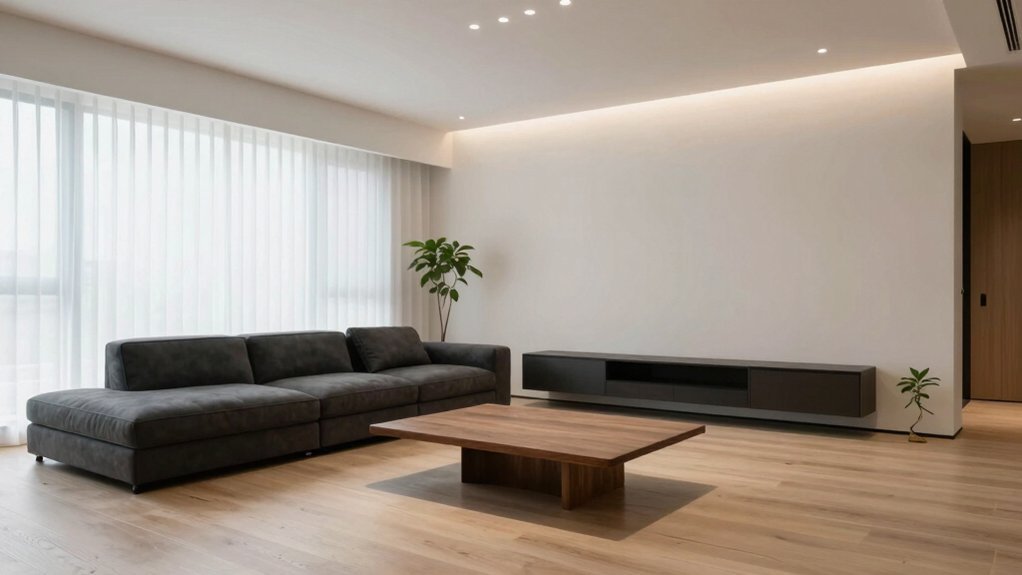
Why fight the room’s dimensions when you can work with them? Low-profile furniture lets you do exactly that. You’ll create visual breathing room by keeping silhouettes sleek and heights minimal.
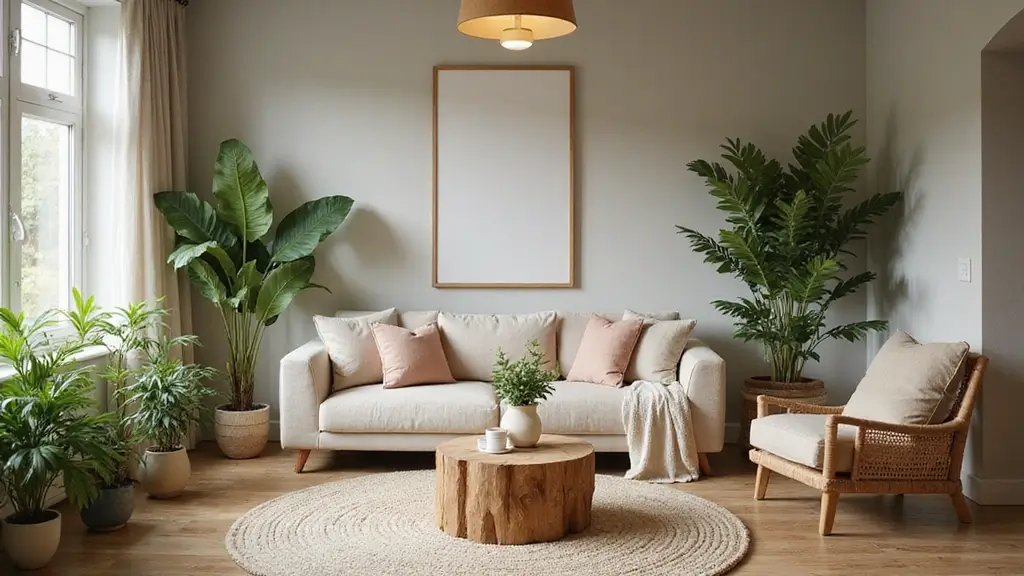
Skip bulky sectionals that devour floor space. Instead, choose sofas with exposed legs and slim arms. You’ll maintain clear sightlines across the room, which makes the space feel wider than it actually is. Opt for coffee tables that sit lower than your sofa cushions—about fourteen to sixteen inches high. You’ll preserve that open, airy feeling without sacrificing function.
Consider armless chairs or ones with narrow frames. They tuck neatly against walls when you need pathways clear. You’ll also want to avoid tall bookcases that tower overhead. Horizontal storage keeps the eye moving across, not up, expanding your narrow room visually.
Recommended Products

Package Included: 10 x Hook Mounting Bracket. Size: 1.6"x1"x0.43"/40x25x11mm(L*W*H), Hanger Groove Width: 0.59"/15mm, Mounting Holes Spacing: 0.7"/18mm, Thickness: 0.07"/1.8mm.

🎁 【47.2" H Large Storage Capacity】It can hold your cosmetics like earrings/rings/necklaces/skincare shelves, spacious storage capacity - store all types of jewelry and accessories

Clear Reflection & No Distortion: Utilizing advanced high-definition float glass, this bathroom vanity mirror delivers a sharp, distortion-free 1:1 image for an accurate and true-to-life reflection—perfect for use in a bathroom, vanity, or above the sink
Create Multiple Seating Zones Without Blocking Flow
How do you keep a long narrow room from feeling like a bowling alley? You break it into multiple seating zones that don’t choke the central path.
You position your sofa perpendicular to the longest wall, anchoring one zone near the room’s middle. You place a pair of chairs opposite, angled slightly open to invite conversation without demanding direct alignment. You add a small console or bench behind the sofa, creating a subtle divider that doesn’t rise to block sightlines.
You keep the main traffic lane clear, maintaining at least thirty inches between furniture pieces. You float pieces away from walls when space allows, letting air circulate around them. You avoid pushing all seating against the perimeter—that only emphasizes the tunnel effect you’re fighting against.
You choose open-base furniture so floors remain visible, expanding perceived space.
Recommended Products

➣Specification: Length 24 inch*width 5.5 inch,1.37 inch extend from the wall.Built-in 100 pcs SMD2835 of 20W(equivalent of at least 100W halogen bulb),2600 Lumens,CRI 85.

Modern Design:The design of the black wall sconce matches with all kinds of scenes, which not only illuminates your room, but also brings a more elegant life.

【High Quality & Antique Design】The wall light fixture with hollow-curved cage lamp shade design with a metal body in a matte black finish, complementary faux-wood panel backing, durable and rust-resistant. Which combine with rustic & industrial elements, could provide instant glamour and visual appeal to your home.
Use Rugs and Lighting to Visually Widen the Room
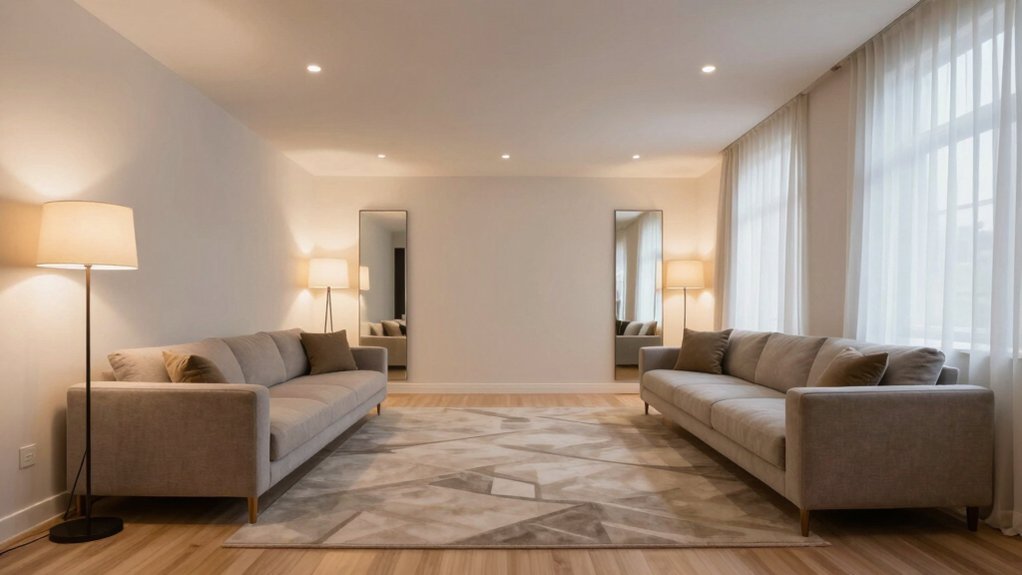
Once you’ve arranged your seating zones, you’ll want to keep the eye from racing straight down those long walls. You’ll break this tunnel effect by placing rugs strategically. Choose wide, horizontally oriented rugs rather than narrow runner styles. You’ll anchor each seating zone with its own rug, positioning them perpendicular to the room’s length. This creates visual width and interrupts the elongated sightline.
Layer your lighting to expand the space sideways. You’ll install wall sconces or swing-arm lamps on the long walls rather than relying solely on end fixtures. Place multiple light sources at varying heights across the room’s width. You’ll draw attention outward and upward, forcing the gaze to travel side-to-side. Dimmer switches let you control mood while maintaining spatial balance. Combine warm ambient lighting with focused task lights to eliminate dark corners that compress your perception of width.
Recommended Products

Ultra-thin & Safe Kitchen Rugs: Our entryway rug is a super cozy crystal pile that is not only super soft, but also fade resistant.The 0.166-inch thick, low-pile runners for hallways is easy to place in entryways and under furniture, and won't block doorways

Non Slip & Durable Rug: The surface of the vintage washable runner is made of premium faux wool, soft and not easy to shed. The bedroom rug has non-slip TPR rubber backing, provides a strong grip to against slipping, and the reinforced overlock edges makes it more durable

STYLISH DESIGN: This trendsetting striped area rug design in a rich warm color palette combination can be perfectly paired with a variety of home décor styles.
Hang Mirrors and Reflective Surfaces Strategically
Where should you position mirrors to double your visual space? Place one large mirror on a short wall at the room’s end. This placement reflects light and creates depth, making the narrow space feel wider. You’ll expand the visual field without adding square footage.
Hang mirrors opposite windows to bounce natural light throughout the room. You’re amplifying brightness and reducing shadowy corners that emphasize the tunnel effect. Consider mirrored furniture pieces too—a console table or cabinet reflects surroundings and adds sparkle without clutter.
Avoid covering long walls entirely with mirrors; you’ll reinforce the bowling alley feel. Instead, cluster smaller reflective pieces asymmetrically. You’re creating interest without elongating further. Position metallic accents and glass decor to catch and scatter light. You’re building layers of reflection that distract from the room’s proportions.
Recommended Products

【Wood Legs Height 3, 4, 5, 6, 8, 10, 12 inch for your furniture】Please choose the right height according to your furniture. Top width 2.76", Bottom width 1.96", set of 4 furniture legs with metal mounting plate, shims and screws

Packaging Content: you will receive 4 sets of couch legs replacements, including 4 pcs triangular plastic couch legs and 12 pcs self tapping screws, 1 sofa foot needs 3 screws, which can easily replace the old furniture feet and increase the use time of furniture

Made of Solid Hardwood: The furniture legs are expertly crafted of high quality solid hardwood, once installed they can withstand loads up to 1800lbs. The surface is covered with a dark color moisture resistant paint for a long lifespan of furniture
Draw the Eye Upward With Vertical Design Elements
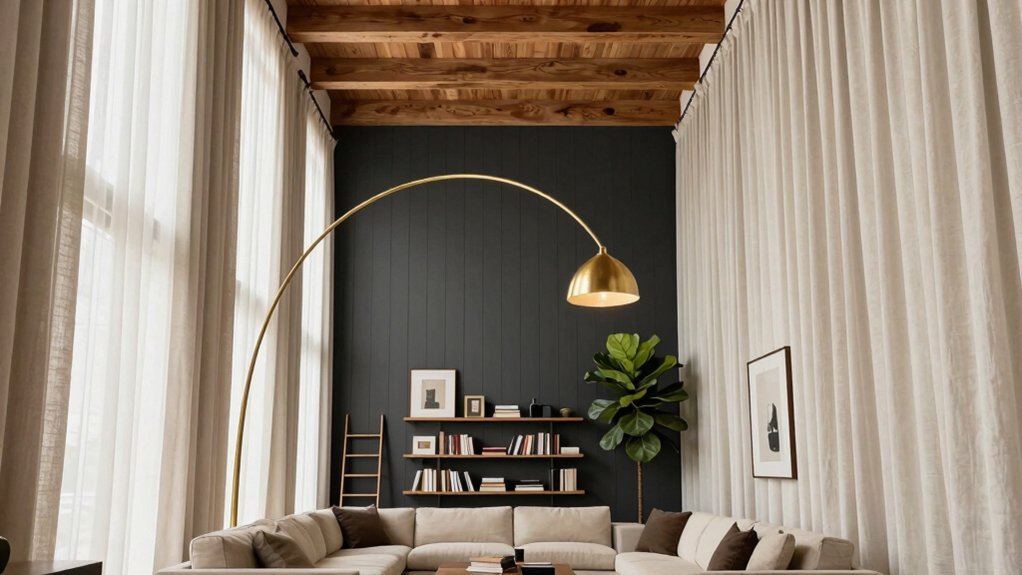
Why let your ceiling height go unnoticed when you’re fighting a narrow floor plan? You’ve got vertical real estate waiting to work for you.
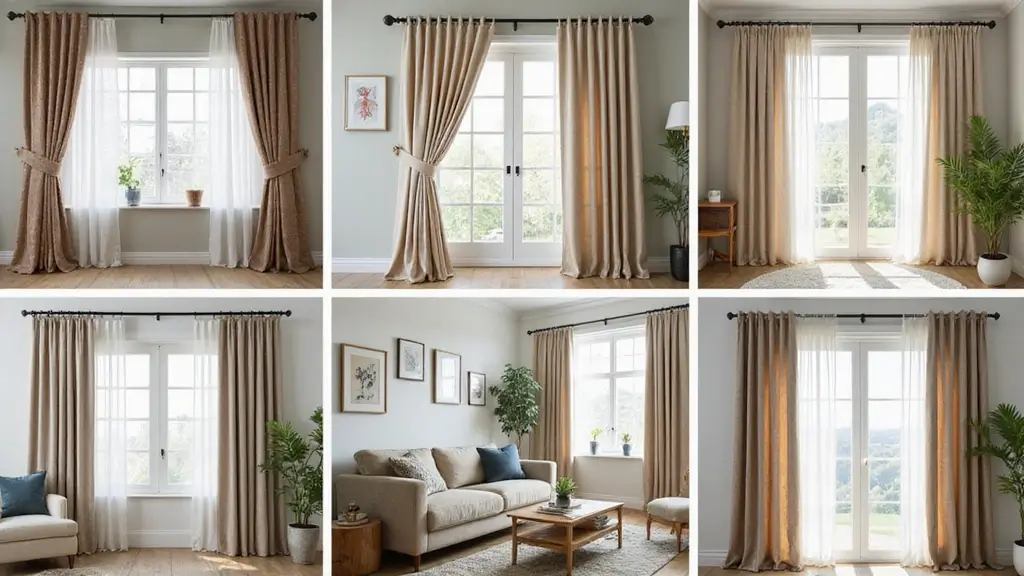
Install floor-to-ceiling curtains that stretch well above your window frames. You’ll force the eye skyward and soften those long walls simultaneously. Position tall bookshelves, armoires, or plant stands at the room’s ends; they’ll balance horizontal stretch with commanding vertical presence.
Hang artwork in vertical groupings rather than spreading pieces wide. Choose pendant lights or chandeliers with dangling elements that occupy overhead space. You’ll break the tunnel effect while adding visual interest above eye level.
Paint your ceiling a shade lighter than your walls, or add subtle architectural details like crown molding or beams. You’re not just decorating—you’re redirecting attention from cramped width toward generous height.
Recommended Products

SOFT FLUFFY RUGS for BEDROOM: With its plush high-low piles, this 5x7 area rugs delivers an incredibly comfortable and soft sensation, making it suitable for going barefoot. Lay the carpet over your hardwood floor, and it not only infuses warmth but also turns any room into a snuggle-worthy retreat

Fluffy Living Room Rug: Quntue shag 8x10 living room rug is made of high quality microfiber and memory foam, the soft and comfortable touch makes you feel like walking on clouds whether you are standing, sitting or lying down; your family and pets will love to play on this living room rug.

[Part of the Solid Shag Collection]: This solid shag rug is a versatile piece crafted from polyester, offering a soft and inviting texture underfoot.The rug showcases a lush, dense pile in a uniform solid color, providing a clean and neutral base for any room. making it ideal for your bedroom, living room, or nursery
Avoid 5 Furniture Placement Mistakes in Narrow Rooms
Vertical elements buy you breathing room, but they’ll fight against you if your furniture works at cross purposes. Push all your seating against the walls, and you’ll create a bowling alley effect that emphasizes the room’s tunnel shape. Instead, you’re floating pieces away from the perimeter to establish conversational zones.
Don’t block your pathways with bulky pieces that interrupt traffic flow. You’re choosing low-profile furniture that maintains sight lines across the space. Avoid oversized sectionals that swallow the room; you’re opting for streamlined sofas paired with armless chairs. Never place your largest piece at the far end—that’s anchoring the eye to the narrowest point. Finally, you’re skipping heavy coffee tables that clutter the center; slender benches or nesting tables preserve precious floor space while keeping function intact.
Recommended Products

[ What You Get ] : 2 pairs 2 Inch french cleat picture hanger X 4 pieces self-tapping screws X 4 pieces self drilling screw X 4 pieces expansion rubber plugs X 4 pieces clear bumpers

(Acrylic Material) : The mirror is made of acrylic material;Eco-friendly plexiglass mirror. shatterproof, it is a great alternative to a real mirror tiles that can break . even if it falls on the ground, it can be used safely, kids and toddler can touch it at close range.

🎁 【47.2" H Large Storage Capacity】It can hold your cosmetics like earrings/rings/necklaces/skincare shelves, spacious storage capacity - store all types of jewelry and accessories
Find Budget-Friendly Furniture That Fits Narrow Spaces
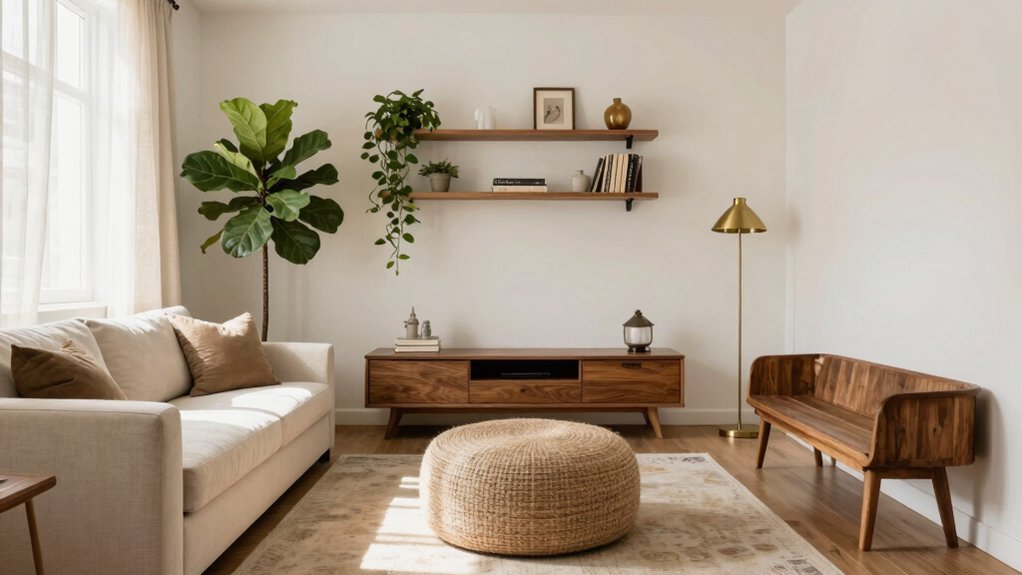
How do you furnish a tight space without draining your savings? You hunt for slim-profile pieces that won’t overwhelm your room’s proportions.
You measure your space twice before you shop. You stick to pieces under 32 inches deep for sofas and choose console tables with minimal depth. You browse thrift stores, Facebook Marketplace, and estate sales for narrow vintage finds that cost a fraction of retail. You seek apartment-sized furniture lines from major retailers—they’re designed for tight quarters and smaller budgets.
You choose leggy, raised pieces that let light flow underneath, creating visual openness. You skip bulky sectionals and opt for a slim loveseat paired with nesting side tables. You prioritize multi-functional items: storage ottomans, sofa beds, wall-mounted desks.
You pull the room together without spending big.
Recommended Products

Modern Minimalist Style: This 5-Light bathroom light fixture features a brushed nickel frame and clear glass shades. Crafted from anti-rust baked varnish metal, it’s durable and ideal for damp bathroom environments. Fits various decor styles, adding classic elegance to your home

Modern Minimalist Style: This 10-Light bathroom light fixture features a gold frame and clear glass shades. Crafted from anti-rust baked varnish metal, it’s durable and ideal for damp bathroom environments. Fits various decor styles, adding classic elegance to your home

[Built-in Dimmer & Energy Saving]: Our bathroom vanity light is equipped with a built-in dimmer switch, allowing you to effortlessly achieve 10%-100% step dimming without the need for an additional dimmer. This not only saves you money but also enables you to customize the brightness to your preference, preventing any energy waste. Additionally, our modern vanity bathroom light is compatible with most dimmers, providing you with the option for stepless dimming if desired.
Conclusion
You’ve got everything you need to transform your long, narrow living room into a space that feels balanced and functional. Anchor your layout across the short wall, keep furniture low-profile, and zone with rugs and lighting. Add mirrors, draw the eye upward, and avoid blocking pathways. Stick to these strategies, and you’ll create a room that’s comfortable, stylish, and surprisingly spacious.